
Top of the morning (?) to you!
Last Sunday I got back from London. I'm still haggling with the jet lag, but mornings walking down leafy streets as I get my morning coffee remind me why I love Vancouver.
Things worth your time
Canadians are wealthier than you'd think – or at least than Americans – Swiss investment bank UBS released its 2026 Global Wealth Report is out and myself and others are grumbling about it.
To put it in context: Canadian economist Jim Stanford and many others long railed against GDP per capita is often used to suggest that, for example, places like Alabama are richer than BC, among other sins. Forgetting the single-mindedness of only using one number (let's compare life spans, shall we?), it's simply not true.
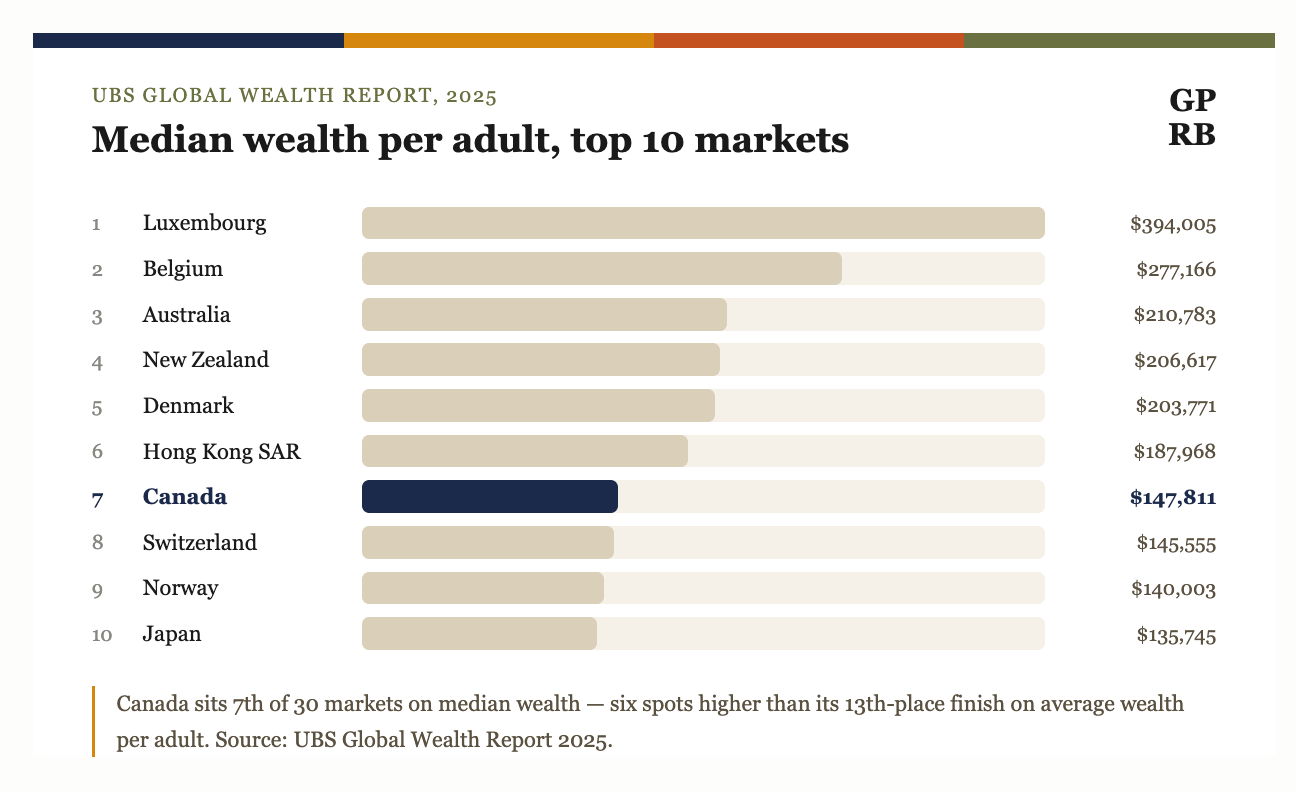
The UBS report dwells, importantly, on the difference between average and median wealth. The US has the second highest average wealth in the world, but drops to 28th when we look at the median household.
Canada is the reverse: while we're 13th in average wealth (i.e., the 1%'s mega wealth divided by the whole population of Canada) rankings, the actual everyday household does even better.
The median Canadian household is the seventh wealthiest in the world.
Furthermore, on average, 66.2% of Canadians' wealth is in financial assets (e.g., RRSPs, TFSAs, etc.) – not just in housing.
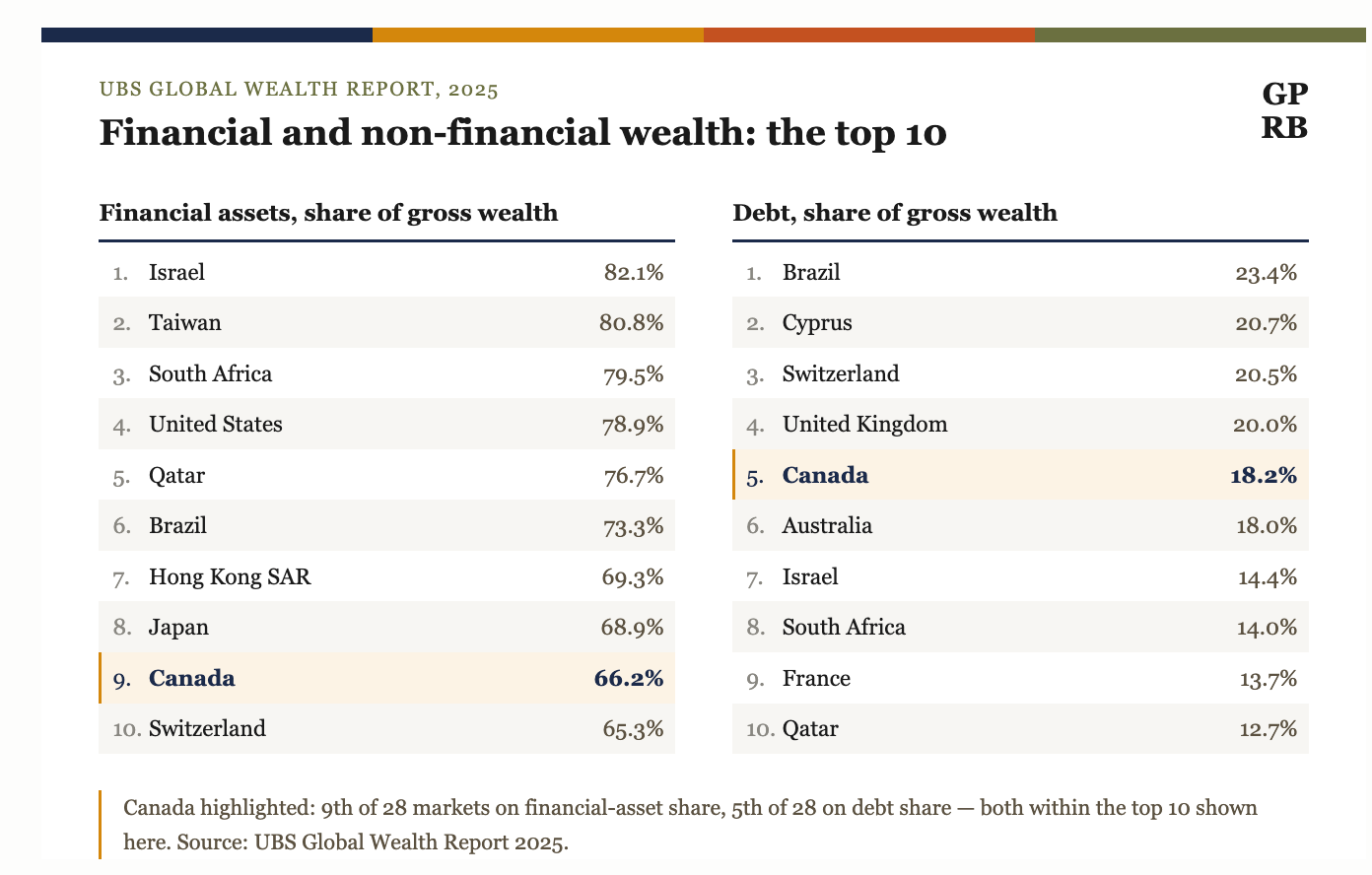
As TD Economics showed earlier this year, the balance between having a really expensive house and having investments is finally starting to shift, as many provinces (including BC) also become less indebted compared to before the pandemic. We still have real problems here, but our direction of travel might actually be the right one at long last.
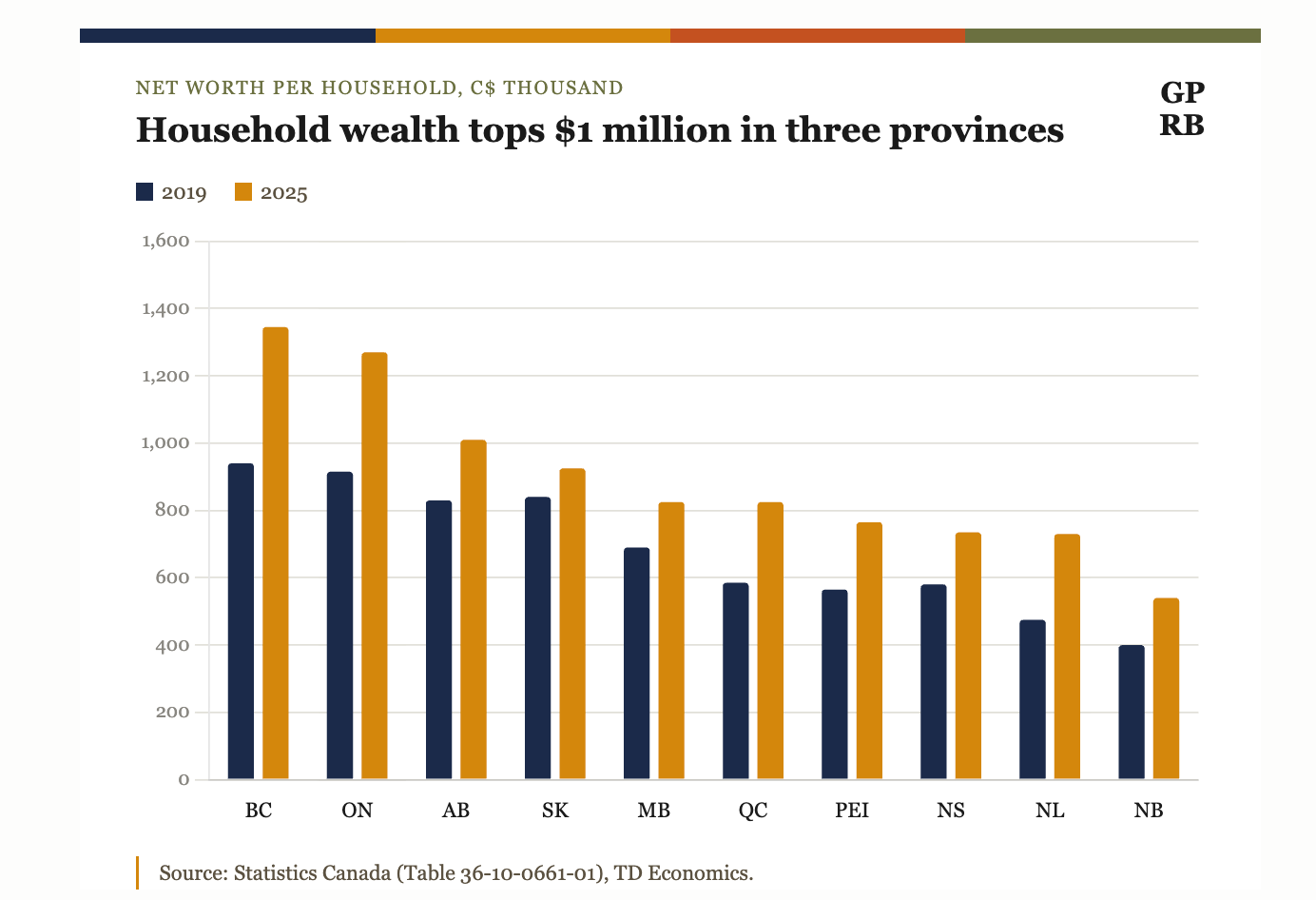
Again, it's not that we've "solved" anything, but there are some signs we might be starting to head in the right direction. TD again:
Earlier in the pandemic, wealth gains were driven largely by housing, as low interest rates and shifting preferences fueled strong gains in real estate. More recently, that dynamic has reversed. Real estate values have been broadly flat to declining, while financial assets have taken over as the primary driver of wealth growth, particularly following the Bank of Canada’s easing cycle. In the latest data from Statistics Canada’s distributions of household economic accounts, financial assets per household rose by 9.9% in 2025 – a record-setting pace.
This is mostly a good news story, even as the historical inequalities around property still linger and strain our social and economic fabric.
A few takeaways I have from all of this:
- Comparisons of averages (rather than median) between Canada and the US are stupid and a waste of time. Don't fall for the trap.
- The Canadian pension system (including RRSPs) is a real wealth-generation vehicle for everyday people, which is partially why our median financial wealth is so high.
- Indebtedness, driven by housing costs, remains a major barrier – with high housing costs having other major economic knock-on effects, too.
I think there's a growing metaphorical rift between camps of powerful people – As the cultural cachet of certain technical professions, particularly those working on or related to software, has steadily increased, I find the business world increasingly awash with pseudo-technical language that's a melange of economics, physics, and programming-adjacent terminology and phraseology.
I'm going on vibes here, obviously, but I perceive a tendency for the early- to mid-career folks to use vastly more software-y or economic terms than in older business speakers. "Platform," "pipeline," "scale," "shipped," "velocity," "nudge," "friction," "transaction cost," and so on.
I think it's firstly part of the ascendance of widespread economic education in the past forty years, where that thinking has crept into most business environments, even if people only take the 100-level stuff.
But the latter part feels more recent, and I notice it when I hear older business leaders talk about the fundamentals of their business and I have a sense of what they really mean; while with younger execs, I'm always doing a little translation (even though I speak the language).
It's a more abstract, almost philosophical way to speak — also heavily influenced by the outsized cultural influence of venture capital and startup culture. VC-speak pervades business spaces in near-hegemonic ways, despite its phenomenally limited applicability.
As someone who grew up reading Og Mandino and Benjamin Graham, it's really striking how laughably quaint and out of touch their metaphors would seem with most of what's there today. Even the older "BUSINESS IS WAR" stuff would feel a bit icky or at least old-fashioned to many today, I think.
Okay, so, there's that shift among business elites and knowledge workers. To be an insider in that world, you need to be conversant in software, economics, and specifically VC-ified language to be taken seriously.
On the other hand, you have what I am going to call "progressive circles," within which I include the broad world of non-profits, both service organizations and those more system-change-y ones (like where I work), some government agencies, small-scale consulting, and much of the social sciences.
Here, the metaphorical drift runs in some different (but not entirely divergent) directions. I see this progressive sphere drawing on terminology from diverse spheres: feminist standpoint epistemology ("lived experience"), systems theory ("leverage points"), somatics ("nervous system"), and ecology.
In many of these spaces, I hear this effort to offer what I would call "gentle" metaphors: You don't eliminate redundancies; you "braid" or "weave" together potentially conflicting efforts. I happen to use this metaphor a lot, because it makes sense to me, but it's interesting to notice it.
There's also a large somatics focus, so you'll hear people say something like: "what's the energy like in the room?" Or what the "felt sense" of something is, or who is "activated." There's also the use of formerly therapeutic language: "hold space," "create a container," "tend to," etc.
Again, all of this is me just reading vibes. I pretend to nothing scientific here, but I just find it interesting how divergent these metaphors are — with one exception: systems change language.
The provenance of the language of systems change, which I would trace back to early cyberneticists like Stafford Beer (though the ideas go back further), is fascinating because it's deeply inflected with physics and biology, though later used by computer scientists and social scientists.
Everyone became fascinated by feedback loops, hierarchies, flows, and leverage points. That lineage and language went on to influence people as diverse as Donella Meadows and Friedrich Hayek to Stewart Brand and adrienne maree brown, who each then interpreted and applied them for their own purposes.
It's very weird and a more than a little unsettling at times. You have this huuuge gulf in most of the way these two high-cachet groups talk, except when it comes to systems, where the orienting logic (though not always the exact terminology) actually has some common root, in my opinion.
It's like the comparisons people have drawn between the concept of patriarchy and "the cathedral." As Battista and Sande explain:
The Cathedral [as developed by contemporary neoreactionaries] is a term to refer to the expansive institutional complex that produces and regulates public opinion to ensure the perpetuation of the “progressive” status quo.
The tenor, and most importantly the intention, of these discourses are diametrically opposed, but they rely on a similar type of intellectual abstraction:
They see individual behaviours and beliefs as shaped by wider systems and institutions that spread and acculturate thought-patterns (e.g., hierarchy, supremacy, inclusion, plurality). Political and cultural success, then, comes from gaining access and controlling those institutions and the downstream systems they shape.
Opposing ends, related strategies.
The language of "the Cathedral" does not have the same cachet, thankfully, but in the United States especially some are certainly trying their best to get it there.
All of this is purely observational; there's no profound or analytical takeaway, but I will say this:
Understanding the logic of someone's metaphors is equally, if not more, important at times than just the actual words they say.
One thing I am still working out
What it will take to sell people on the idea of gentle density.
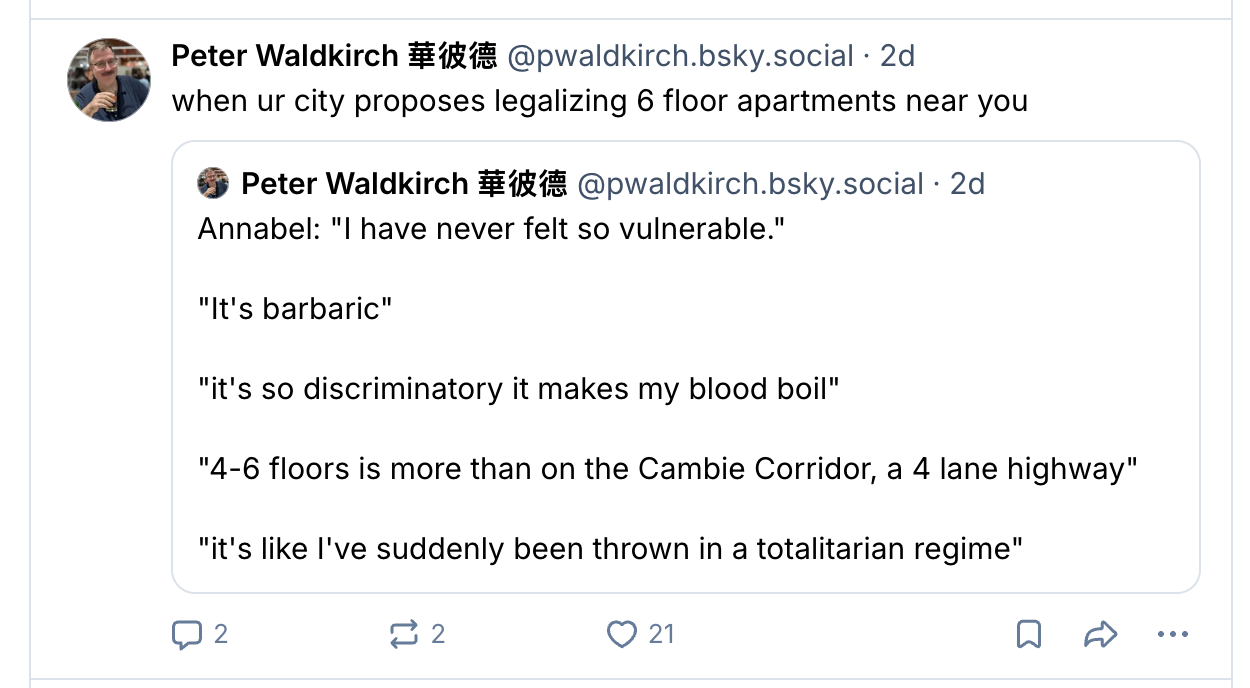
Vancouver housing activist Peter Waldkirch has a detailed, if rather depressing, thread on the city's most recent council hearings on a new "villages" plan, which would bring gentler density throughout the city.
Many did not like it.
Some were outright apopleptic.
I had honestly thought Vancouver had turned a corner somewhat, particularly after watching parts of the West Side hollow out since COVID, too expensive for anyone new to move in, and then unable to maintain many of their local amenities.
It's an election year, so, I don't consider this vote to be especially indicative, but there's still a broader question at play here of how we build support for this kind of activity.
Easy listening
I first heard this in indie masterpiece Elizabethtown and I've been obsessed ever since.
If someone forwarded you this and you want to subscribe, you can do that here. If you want to reply, I read everything.