
Good morning!
This edition of Public Learning is coming a day late because I fell down a rabbit hole researching a few different pieces in it; I hope you enjoy the extra attention I brought and the things it helped uncover.
Fall has arrived suddenly and without warning here in Vancouver. Months of swampy heat and frenetic energy across the city have been transmuted into the cool, austere contemplativeness of this new season.
Despite the lurch between seasons feeling more abrupt than at any time in my memory, for British Columbians – and I suspect many Canadians – the rain we used to complain about in the winter now registers as something of a relief. This new season marks the end of not only summer, but something else darker and more ominous, defined by what Vancouver author John Vaillant has called "fire weather."
I feel a shiver for what this winter might yet bring. The tragedy that has occurred in Nepal feels like what might be an opening act for something worse, though I hope not. I take comfort in the words of Rebecca Solnit:
This is a paradise of rising to the occasion that points out by contrast how the rest of the time most of us fall down from the heights of possibility, down into diminished selves and dismal societies. Many now do not even hope for a better society, but they recognize it when they encounter it, and that discovery shines out even through the namelessness of their experience. Others recognize it, grasp it, and make something of it, and long-term social and political transformations, both good and bad, arise from the wreckage. The door to this ear's potential paradises is in hell.”
Things worth your time
The super El Niño is a 90s throwback, and not in a good way – the World Meteorological Organization (WMO) is reporting that the atmospheric and oceanic phenomenon that most of us get confused about is here – and it's going to be big this time.
Fundamentally, the El Niño–Southern Oscillation (ENSO) is a climatological event that combines two major Earth systems – the lower atmosphere and oceans – in a complex, not-quite-regular "supercycle" between high, neutral, and low states of temperature, driven by two interacting processes.
The Walker circulation is where air warms and rises over the western Pacific, sinks over the cooler east, and returns across the ocean as "trade winds" close to the surface.
The Bjerknes feedback is where winds "pile up" more and more warm water westward, creating a spectrum of oceanic temperatures from cool to warm, east to west.
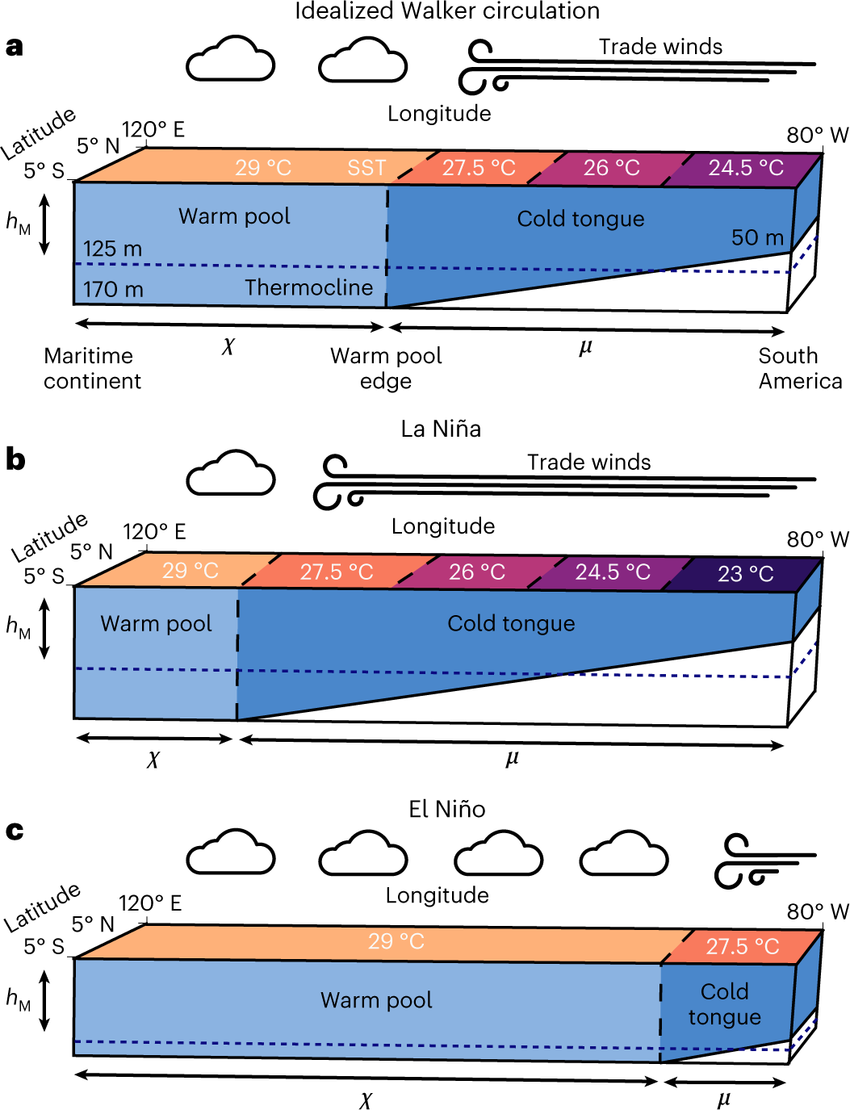
The idealized interaction between these systems (top part of diagram) creates a "normal" cycle of seasons, temperatures, and weather, but different interruptions in the trade winds can cause imbalances and eventually break the cycle, leading to El Niño or La Niña events.
And that's just a conceptual explanation; while the system has core features (e.g., water moving), it's also highly dynamic and occasionally does unexpected things, like when oceanic temperatures dropped during the 1997-1998 El Niño (when they "should" have risen). The scale of that particular ENSO, one of the largest in recorded history, was so large that it is estimated to have bleached and killed 15% of the world's coral reefs and caused economic damages between $4.1 and $5.7 trillion dollars.
The "super" moniker being applied to this particular El Niño has, at least for me, been rather meaningless. But understanding more about the 1997-1998 event puts it in context and helped researchers at the Peterson Institute for International Economics come up with this startling estimate:
six-year cumulative losses to year-one losses—approximately 17.8 times, derived from their figure 1D—yields a six-year estimate of roughly $17.6 trillion, with a confidence interval ranging from $7.2 to $28.5 trillion based on the path of the 1997-98 El Niño event.
They note that these impacts fall heavily on lower- and middle-income countries in the tropics, like Ecuador, Malaysia, and Zambia. The impacts come from reduced farm harvests, natural disasters, and elevated disease burden.
Closer to home, ClimateData.ca has extrapolated the impacts for Canada. A few things stood out to me from their analysis:
- British Columbia and the Yukon are likely to experience a uniquely brutalizing combination of atmospheric rivers (remember 2021?); lower-than-normal snowpack and droughts; and increased burned areas from lightning-related forest fires. In addition, the changes in ocean temperatures can impact shellfish health and cause mackerel (not normally in BC waters) to move further north and prey on juvenile salmon.
- In the Prairies, they're expecting reductions in winter precipitation and therefore spring runoff, leading to decreased soil moisture, increased wildfires, and farm yield-reducing droughts.
- In Central and Atlantic Canada, temperatures will generally be warmer and wetter, increasing the likelihood of flooding and unique imbalanced weather events.
The ENSO itself has a very complex relationship to climate change, with scientists still debating how the phenomenon itself works, let alone how climate change may alter it. But what is certain is that this El Niño will sit on top of and exacerbate those impacts.
One small upside? The brutal forest fire season this year (which was definitely exacerbated by climate change) bumped climate change up as the top issue for 21% of Canadian voters. As floods and droughts and lord knows what other plagues befall us, that number may yet climb again and push for action that feels waning at best these days.
British Columbia's unique unionization rules are helping Uber drivers – The Tyee is reporting that over 1,000 ride-hailing workers in Kamloops and Kelowna are now joining the United Food and Commercial Workers (UFCW) Local 1518, known for previously organizing Victoria-area drivers.
The union was ecstatic. You can actually read the whole collective agreement on the BC Labour Relations Board website, and see why they were so excited by the accomplishment, both for the represented workers, and for what it might signal is to come.
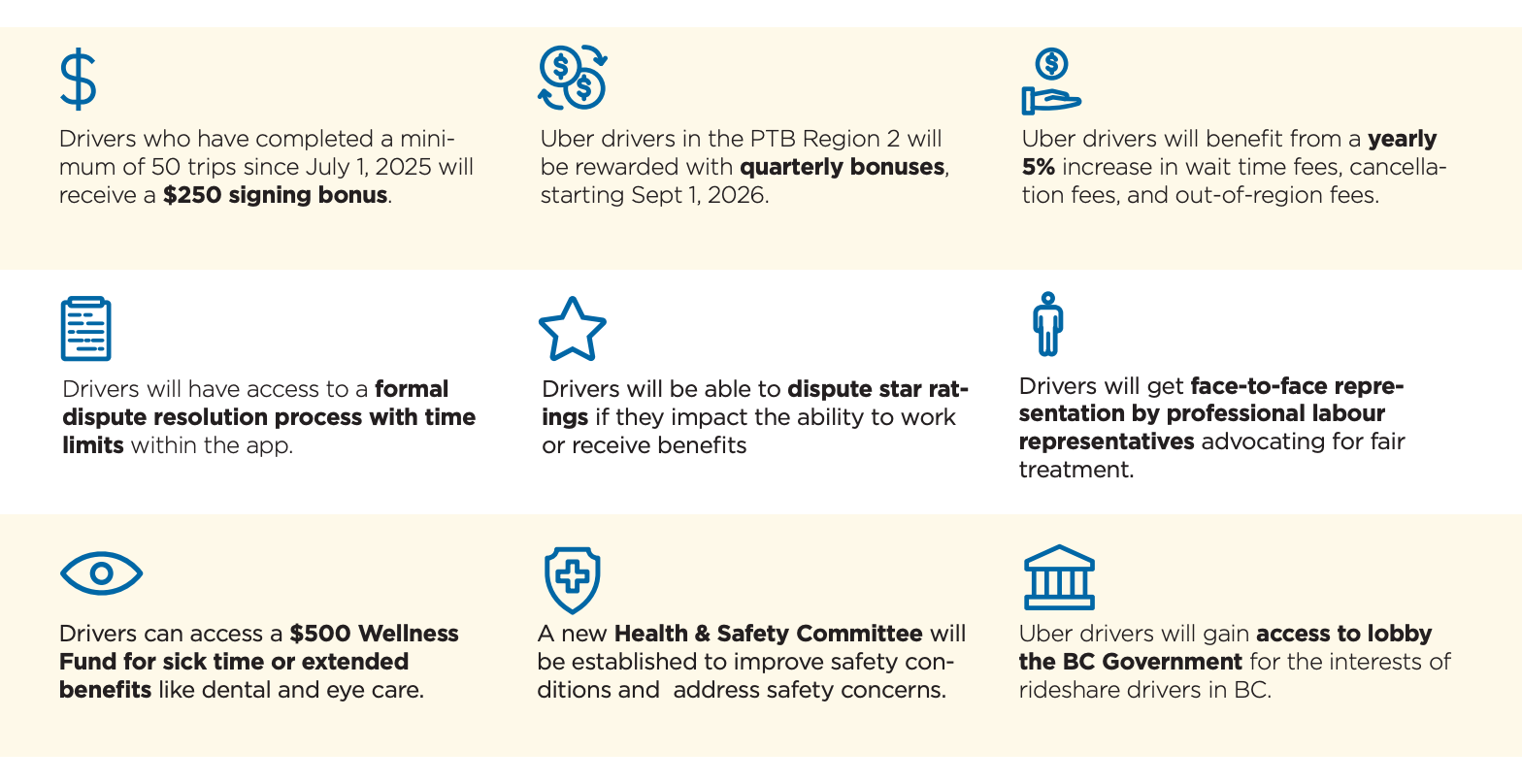
The agreement was made possible by a BC law passed in 2024 that did things like set minimum-revenue per kilometre standards, prevent companies from holding back tips, and ensure workers are registered with WorkSafeBC.
Though undoubtedly Uber and other platform companies would not like to have to do this at all, there are some claiming that they understand this approach is an effective mitigation strategy for something even bigger. Earlier in August, Brian Dobler argued in Jacobin that the American versions of these agreements could be viewed as simply new forms of "company unions," where workers are largely excluded and may not even be able to strike, depending on the state-level legislation.
There are critics at home, too. When the original law was passed in 2024, Veronique Sioufi of BC Policy Solutions noted that gig workers still wouldn't have access to all benefits of BC's Employment Standards Act, such as vacation pay, benefits, pensions or employment insurance. This new agreement, notably, does not mention insurance.
It's clear the UCFW agreement and others are absolutely an improvement on the prior system, but Dobler points to the International Labour Organization's new standards for "decent work in the platform economy" as the north star to work towards.
One Thing I am Still Working Out
I'm spending a lot of time thinking about software tools these days as I try to find the right balance between recording and tracking things for posterity, and actually doing the work I need to do.
I'm known as something of a Microsoft hater, and the more I develop the specific use cases for different tools to amalgamate and synthesize information and decisions, the more I come to loathe the bloated, inefficient, and predatory enterprise software ecosystem they have created. Their end game, naturally, is vendor lock-in.
What I can't puzzle out, particularly in an age of "elbows up" Canadian sovereignty, is why governments (and other organizations) continue to allow this kind of predatory capture to happen. It's bad. We know it's bad. We know that the United States considers data on servers in other countries, but owned by US companies, to be under American jurisdiction.
Why aren't we breaking free and building new software ecosystems that are not only sovereign, but open source?
Easy Listening
I spent a surprising amount of time last weekend listening to Padre Guilherme Peixoto, a "DJ priest" famous for pretty fun sets and, uniquely, endorsement and blessings from Pope Leo XIV.
I honestly love the music, but I am also deeply fascinated by the idea that the Catholic Church would enable someone to perform in this way as a way to reach new audiences. With people so lonely and disconnected, is this part of the future of religion?
If someone forwarded you this and you want to subscribe, you can do that here. If you want to reply, I read everything.