
Good morning,
The dog days of summer are here, and I'm tremendously excited to spend the last ones on my bike. Many know that I am not a terribly mechanically-minded person, so getting a new one this week was a stretch for me, but the flow of endorphins I felt the second I started moving on it was a reminder to me why I love it so much.
I'll do a loop through Galiano Island with Liam Orme this weekend, and then head over to the Victoria Forum at the beginning of next week. This year's program is completely jam-packed with incredible content. I'm particularly excited for a panel with my longtime friend and mentor, Deb Harford, on the panel with Thomas Marois and friends, around the concept of developing a "Municipal Development Bank" in Canada.
I've written on these kinds of ideas before, and I'm really excited about the deep thinking that Thomas is doing to build them out. I hope to interview him in a later newsletter.
 George Benson
I'll share more in a subsequent newsletter. For now, stay cool.
Things worth your time
An impending gas crisis in Europe is driving the case for electrification – The European Union (EU)'s gas stores are 15% lower than where they were this time last year (about 61% full). Europe's leading gas futures price, Dutch Title Transfer (TTF), has now risen to its highest point in 2026 – above what it was even when the war in Iran broke out.
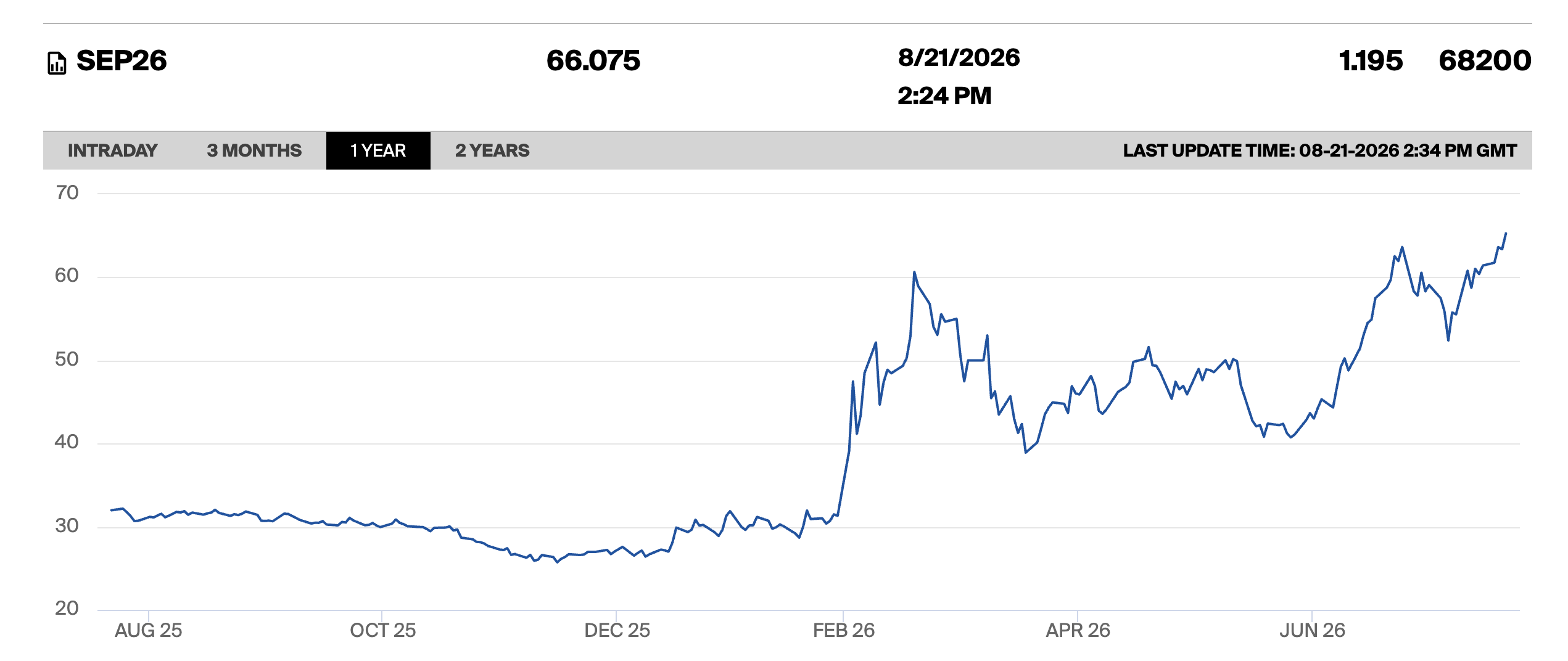
The gas industry is pushing for the Europeans to create a range of incentives to promote the development of greater storage capacity in the EU. Their argument is, even in a world with significant decarbonization – somehow defined as only a 12% reduction in peak demand by 2040 – the EU needs greater ability to buy gas quickly and store it.
While more storage and different incentives may increase the buffer of European stocks into the future, it doesn't change the fact for now that the globe will continue to have eye-watering prices. As Wood Mackenzie described it, "Europe is approaching energy crisis territory."
The EU is continuing to work to bring more gas into its stores, but, at the same time, also launched a "hugely ambitious" Electrification Action Plan, which aims to double economy-wide electrification by 2040 and reduce gas demand by 65-70% in the next fifteen years. Some of the most interesting parts of the plan, to me, were:
- Create regulatory sandboxes and "living labs" for vehicle-to-grid charging infrastructure;
- Promote the introduction of "smart charging" contracts as the default in new EV-linked electricity contracts;
- Create a common rating scheme for data centres to ensure minimum performance and promote flexibility in their loads;
- Promote cross-border collaboration around faster nuclear permitting timelines;
- Launch a second industrial heat auction as part of the Innovation Fund in 2026
- Explore the potential and barriers for deploying direct-use renewable heating technologies, like thermal energy storage;
- Review the Clean Vehicles Directive and possibly ratchet up zero-emission vehicle requirements;
- Quoting directly here, "explore possibility to introduce a clean heat market mechanism to incentivise rising shares of heat pump sales from manufacturers, redirect installers and manufacturers to clean heating and cooling solutions and boost competition, narrowing the upfront costs difference for heat pumps by 2027;"
- Adopt an EU-wide Cooling and Heating Action Plan to increase uptake of cooling for buildings;
- Integrate these electrification goals into the European Strategy for Vocational Education and Training; and
- Build a "wide coalition of countries" committed to clean electrification, with a goal of tripling global renewable energy generation and achieving 35% economy-wide electrification by 2035.
Extrapolating from the EU's work and various efforts across developing markets to reduce gas, Wood Mackenzie believes that "with over 250 Mtpa of new LNG supply under construction, an over-supplied LNG market from 2028 remains the most likely outcome."
The IEA is already reporting that global gas demand has contracted by 0.5% this year.
The Canadian Constitution is having (not a great) moment right now – There are a bunch of big constitutional issues swirling in Canada right now. There's the Cowichan Decision on Indigenous Rights and Title from last year. A new lawsuit around what has been claimed to be a unilateral constitutional amendment by the Government of Quebec to remove the need for an oath to the King.

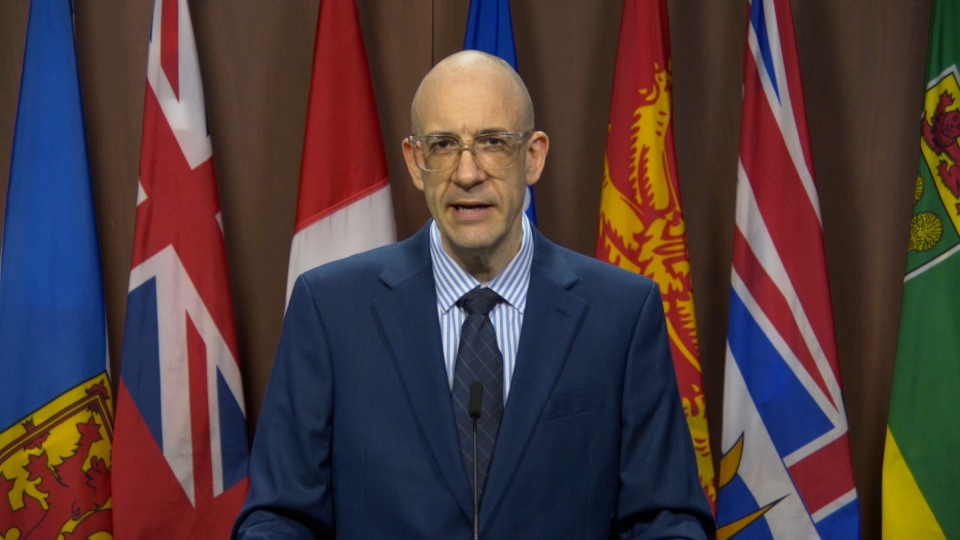
And Doug Ford in Ontario is now triumphant in being able to remove bike lanes in Toronto, overturning a previous decision that hinged on whether or not the government had been capricious and arbitrary in trying to remove them basically on the basis of vibes. I wrote about this last year.
 George Benson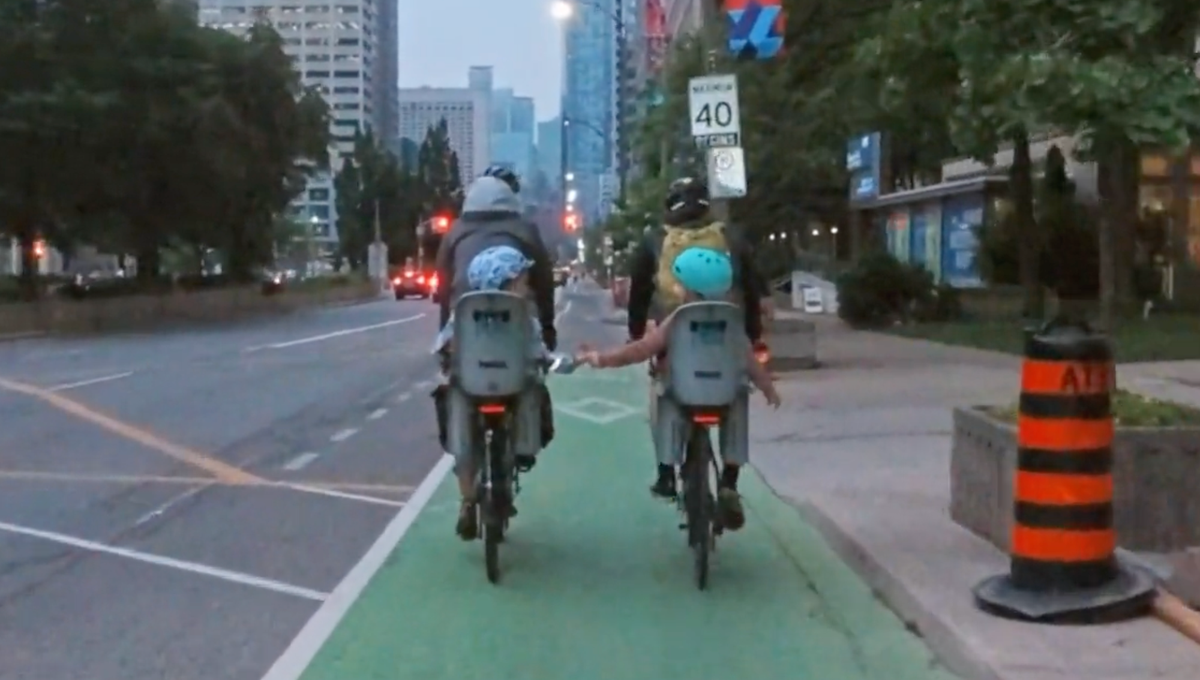
These cases all illustrate to me the ways in which the constitution is creaking under the weight of contemporary issues and fault lines.
I'll be watching at the Victoria Forum this year especially to see if the conversation around amendments emerges and, if so, in what contexts.
One Thing I am Still Working Out
Where is everyone online these days?
I've been an early adopter of almost every social media trend, from MySpace, to Google Wave (lol), to Tumblr, to Mastodon, since the mid-2000s, and as my social media world shrinks to more or less LinkedIn, with some Bluesky and Substack on the margins, I have less and less sense of what the internet's zeitgeist is and, perhaps more importantly.... just what everyone's doing online.
It feels like the online equivalent of everyone having headphones on and looking at their phones on the train. We're spending more time online than ever, yet I don't think I've felt so digitally disconnected before.
Is my vibe-check right? What do you think?
Easy Listening
Brian Eno, the granddaddy of "ambient music," did a truly spectacular interview with Ezra Klein last summer. Across a conversation that touched on the nature of creativity and consciousness, the wide-ranging, gentle curiosity of this great artist radiates outwards like a humanistic fire to warm your spiritual hands at.
At the end of the interview, one of the three albums that Eno recommends is the husband-and-wife duo, The Consolers. These iconic more-than-gospel singers have brought my heart some calm in difficult days this summer.
If someone forwarded you this and you want to subscribe, you can do that here. If you want to reply, I read everything.