
George here; thank you for joining me for Public Learning. If you're starting here for the first time, my initial edition of this newsletter lays out what I aim to do here, including the beginnings of what a philosophy of public learning means to me.
Things I am learning
For all the talk of increasing investment in Canada, small businesses and local economies feel the squeeze more than ever. Social Capital Partners has raised the alarm that between 2019 and 2024, only 11.5% of all outstanding business loans in Canada went to small and medium-sized enterprises — compared to 44% on average across the OECD. This builds on the larger picture that I’ve been following from the Competition Bureau of Canada, which has shown that between 2000 and 2020 the Canadian economy became steadily more top-heavy, with large firms raising prices and keeping out future competitors.
Practical strategies to put communities and small businesses back in the drivers seat, therefore, are much needed.
Enter the fascinating Zita Cobb. Born to the once phenomenally poor Fogo Island in Newfoundland and Labradour, she's now spent a lifetime helping – and succeeding – in turning her community's fate around through smart, values-driven local economic development.
Now, as the head of the Shorefast Institute, she had had brilliant things to say on a CBC Ideas panel with Lisa Raitt and Kylie Tiessen.
Her life was set on a radically different course, she said, when her father realized that outsiders to their community were "turning the fish into money," and the pre-cash society that she lived in would have to change radically if it was to survive in the twentieth, let alone twenty-first, century economy.
She and the Institute now advocate for a particular brand of thoughtful, place-based economic development that's much needed in Canada, and elsewhere.
It couldn't come at a better time.
Canadians don't understand our constitution. Indigenous Treaty rights had a big win in Alberta last week, when Elections Alberta’s plan for a provincial referendum on secession was struck down in court.
But the headlines rest on a misinterpretation:
Most reporting suggests that the very idea of Alberta seceding is, by virtue of treaties, illegal. But that’s not what the judge said.
Recalling the earlier Sylvester decision that also ruled against the referendum, Justice Leonard speculated that:
"Perhaps an independent Alberta would adopt a provision like [section 35 of the Canadian Constitution] and recognize and affirm Treaty rights, but, for the reasons explained above, Alberta cannot succeed to the Numbered Treaties without the consent of First Nations."
In other words, for a referendum to proceed, it must respect the basic precepts of the constitution under which it operates today, which in Canada includes the Treaty Rights of Indigenous Peoples as laid down in Section 35 of the Constitution. This makes it clear that a referendum proposal that engages with First Nations and develops a question with those rights embedded could very well proceed to voters.
This feels important to reflect upon in light of the debates in B.C. regarding the future of the Declaration on the Rights of Indigenous Peoples Act (DRIPA). A repeal of that particular law – which is really a framework for embedding constitutional principles in how our government works here, may create the illusion that some great "barrier" is being removed, but it does not alter Canada's constitutional foundations.
Treaties form part of the fabric of our country; they therefore do not just belong only to Indigenous peoples, they shape how we all participate in this country.
Before people rush to disparage them and think cleverly about how we might circumvent them, a deeper, more patriotic question to ask is: how might we make the most of what we already have?
Anthropocene astrobiology reaffirms planetary limits. Astrophysicist Adam Frank summarized research in Big Think that he and his colleagues have been working on since 2018 about how the “Kardashev scale” — a way of measuring societal complexity based on how much energy it uses — misses the limitations that the biosphere places on how large a society can grow.
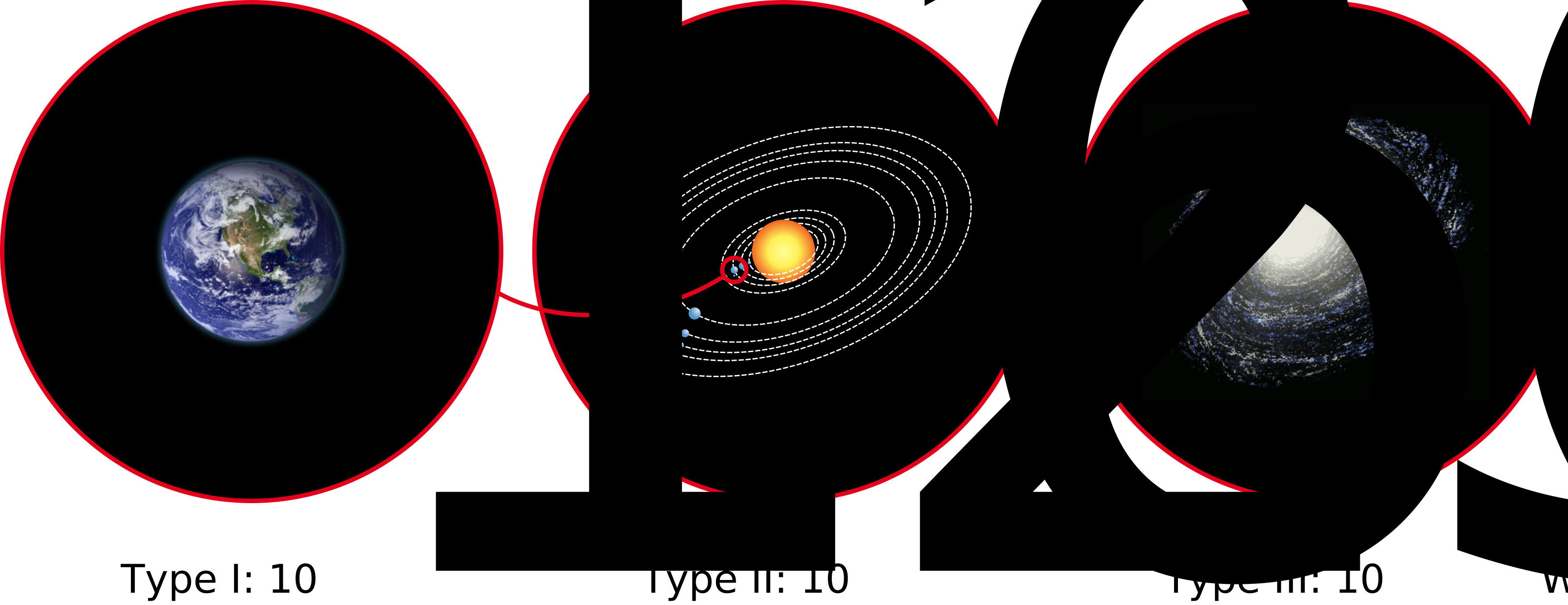
The essence of Frank et al’s research is that there are “smooth entries” into sustainable states of very high civilizational complexity (e.g., harnessing most/all of the energy of the sun), but there are also many "filters" where consumption grows too quickly for the biosphere to manage everything entering that system, and the system (i.e., the biosphere) collapses outright.
All of this is part of their (extremely awesomely named) "astrobiology of the Anthropocene," but also basically builds on the fundamental premise of one of the foundational documents of modern environmentalism: The Limits to Growth. Aptly named, the 1972 Club of Rome report shockingly found that if you consume and pollute endlessly, you degrade, or even destroy, the systems you depend on.
Fifty years of updates and revisions later, the conclusions – and the warned-of trajectory humans were on – haven't changed.
One thing I'm still working out
I don't know how to fully conceive of Canada’s industrial capacity. It's a disparity between economic output (which is still large), employment (which is much smaller), and, for lack of a better word, vibes.
From the standpoint of the big-picture numbers, Canada remains a major industrial economy. Still, in key segments (I'm learning a lot about the electricity transmission sector these days), we just seem to be on an endless downward slide – part of the overall collapse of business investment in Canada outside of the oil and gas sector over the past two decades. You can see and feel it when whenever we begin to look for something we actually do make in this country that's meaningful to our own prosperity.
When I think about the big things we need to build, from an upgraded grid to sovereign compute to defence technologies production, I'm flummoxed with even how we conceive of the diffuse industrial base we do have, much less how we target and deliver its renewal.
Easy listening
The Turakina Maori Girls Chair does a hauntingly beautiful rendition of the faux Maori song "Now is the Hour," pitch-perfectly used in Project Hail Mary.
If someone forwarded you this and you want to subscribe, you can do that here. If you want to reply, I read everything.