
Greetings,
Summer truly feels like it’s arrived, and I’m working to enjoy the sun and warmth as much as I can before forest fire season starts in earnest. I managed to make my way up to the top of Whistler Mountain last weekend for the first time ever and, despite the price tag, I found it all rather breathtaking.
Next Friday I leave for London, so expect a briefer note when there. But for now:
Two things worth your time
The global economy has been wounded, and an unstable peace won't change that. While the announced MOU to end (or at least pause) the conflict between Iran and the United States appears to have been pretty disastrous for Trump, the world is collectively crossing its fingers it sticks.
A series of genies wreaking havoc are already out of the bottle, however.
While people in wealthy countries are mostly worried about faltering economic growth (the World Bank estimates just 1.3% in 2026), inflation in the global south will be even worse, rising to 4%.
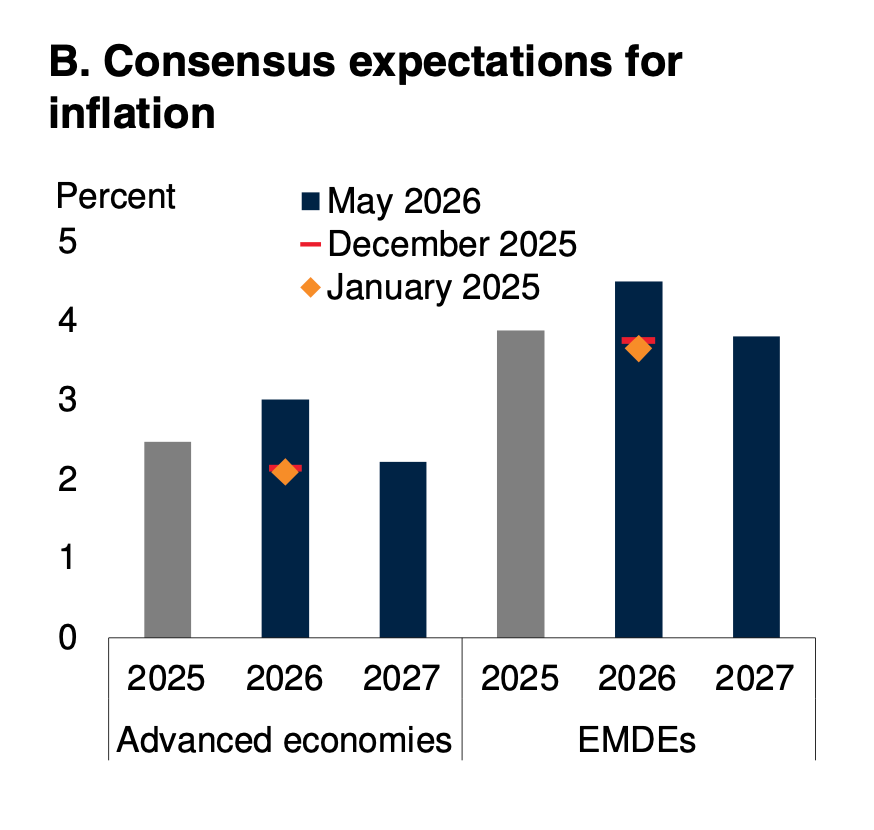
Most starkly, the Chief Economist at the Food and Agriculture Organization (FAO) offered a simple prognosis on the impact of the war: a slower, poorer, and hungrier world.
A cruel, pointless thing to have done.
OSINT continues to evolve. When Russia invaded Ukraine in 2022, I followed the first year of the war obsessively. Like many Westerners, insulated from violence, I watched it elsewhere to a fault. In many ways I think it prevented me from being an effective contributor to the cause. Instead of volunteering my time, I consumed.
Part of what made that possible (for good and for ill) was the world of “open source intelligence” (OSINT).
In a nutshell, OSINT is the practice of using publicly accessible information, especially social media content, satellite photos, and other data, to generate intelligence. The OSINT world is fascinatingly heterogeneous, with professional investigative journalism firms like Bellingcat and vibrant communities of amateurs on Reddit, X, and Bluesky.
Though massively scaled and distributed with the advent of social media and the internet, the practice of using publicly accessible records to draw useful strategic insights is not new. The CIA-precursor, the Office of Strategic Services (OSS), had a Research and Analysis Branch that looked at every piece of information that American enemies produced, no matter how banal, to find unique insights. As OSS Director and OSINT pioneer William Donovan once said:
“Even a regimented press will again and again betray their nation’s interests to a painstaking observer”
More broadly, especially as OSINT intersects with cyberwarfare, it reflects the changing nature of conflict and how multifaceted it has become. Though old now, Russian Chief of the General Staff Valery Gerasimov’s writings on the subject are fascinating and give a window into a very different way of thinking about conflict.
OSINT’s track record is frankly phenomenal. From simply watching Google Maps to catfishing on dating apps, the possibilities — both military and civilian — have most vividly come to the fore during the Russian-Ukrainian war, but have broad application in human rights and corporate oversight, not just warfare. And while many intelligence agencies have their own internal teams, it’s an open secret that many also simply watch the voluminous output of amateurs.
But the internet is closing up, and shifting the landscape. AI web-scraping in particular, but broadly a move to more enclosed ecosystems on the part of large platforms, is shifting the ability of analysts to work at scale — not to mention limiting everyday functionality.
At the same time, I still see that secrets are harder than ever to keep – and citizens can hold unique power because of that. Bellingcat sharing its newest Online Open Source Intelligence Toolkit and even offering courses on OSINT gives me optimism that dedicated citizens, and not only paranoid governments, will continue to uncover wrongdoings and mobilize these in the support of the public good.
Easy Listening
As a longtime Phillip Glass fan, I'm drawn to music that combines simplicity and repetition and scale. Dan Deacon is one of very few artists I've encountered who matches Glass' ability to deliver things so profound with very simple constituent parts.
Deacon's America is probably the best example of this, with the album's culmination in USA I, II, III, and IV offering what feels like a truly transcendent experience.
If someone forwarded you this and you want to subscribe, you can do that here. If you want to reply, I read everything.