
It's election season, and I am exhausted.
With Vancouver today, BC voting in a week, a referendum in Alberta, and, god help us all, the American midterms, my body is in an active fight-or-flight state every time I read the news. Part of this is the normal reverberations of elections, the rumble of speeches and press releases that make promises that might change the lives of millions, or circumvent profound harms that reach the same number.
But there has been something particularly ugly about much of what I have heard and seen so far. Hateful things said, willful fantasies indulged, and through so much and by so many, an unwillingness to confront the bare reality that we are amidst epochal shifts in our society. These shifts -- climate change, inequality, technology -- make our problems harder and more complex.
But I can also feel the exhaustion of the electorate. We are not receptive to much these days, disbelieving anything but the most banal at times, and sometimes even then.
I also know that I am a particular kind of voter; I'm a wonk. I'm looking for the kind of political substance that spends equal attention and ferocity in identifying how we will fix problems as what those problems are. To say that most elections leave me disappointed in this respect would be a gross understatement. If you're reading this, I am going to assume you probably feel something similar.
Part of moving through my frustration with all of this has been to try to understand how our thought- and speech-patterns about political problems and solutions have changed. As you'll see, political speech has moved away from complexity towards answers that feel intuitively coherent, rather than grounded in reality. This is the kind of politics that promises to "x the y," and tends to focus on the most visible aspects of a problem (often its cost) – and ignores the structural (i.e., state capacity) issues that actually hold us back. Sometimes it still gets things right, but more often than not, it demurs on the hard choices – and leaves room for the strongman who promises to just get something, anything, done.
The antidote is a promise you can check. Something that is clear about the difficulty faced, and lays out the full costs, and who pays. It takes on the whole problem rather than its most visible part, and it admits that delivery takes longer than an election cycle. Very little of what we've heard this fall clears that bar.
So, as the title says, I built a model to show what a credible political promise looks like, using Vancouver's most-repeated one: the SkyTrain extension to UBC (UBCx). It costs the project out, then hands you the trade-offs involved in paying for it. With Vancouver voting tomorrow and the province a week later, that is the bar every candidate on your ballot should have to clear.
The subtly changing nature of our political speech
There is a longstanding belief in the English-speaking world (thanks, Orwell) that how politicians speak and how we citizens speak about politics – and therefore the substance of our politics itself – are, quite simply, getting dumber.
On the one hand, this fear is somewhat overblown. We use much shorter sentences, yes, but the idea that all of our politicians speak like fourth-graders doesn't really hold water. The less visible, more concerning trend is what we can call the move from complexity to confidence.
Today's political leaders speak more intuitively and less analytically than they used to. Well beyond the English-speaking world, political language has grown simpler, in legislatures from the Bundestag to Brazil's Congress and in the work report China's premier delivers each year. The deeper shift, in tone, is where the evidence is strongest. Looking across English-language politics in 2019, researchers Kayla Jordan, Joanna Sterling, James Pennebaker, and Ryan Boyd put it concerningly:
"voters may increasingly be drawn to leaders who can make difficult, complex problems easier to understand with intuitive, confident answers."
Canadians probably associate this with the particular kind of "verb the noun" politics our federal Conservative leader, Pierre Poilievre, is known for. But I want to stress something that should make all my readers uncomfortable:
This trend towards confident, simple answers to complex problems is shared by politicians across the entire political spectrum.
I am not making the banal claim that "all politicians are the same," or that there is no difference between the left and right. What I am saying, and what recent history shows, is that we, the public, react positively to (and have come to reward electorally) leaders who speak confidently about problems and identify solutions that feel intuitively true.
"I will fix the housing crisis by building more houses."
"I will fix schools by firing the bad teachers."
"I will fix the deficit by cutting spending."
"I will fix the healthcare system by hiring more doctors."
"I will build the [project you want] cheaper, and faster than the other guy."
The housing crisis, climate change, government debt, and infrastructure are all exceedingly complex topics – and only growing more so by the day. Jordan et al. theorize that it is exactly the impenetrability and interconnectedness of most big societal issues that are driving both politicians and voters to use speech to make these issues feel intuitively comprehensible. Canadian philosopher Joseph Heath calls this "pudding" before "meat" politics – big promises, little consideration for delivery.
Hidden underneath these smoothly simple promises, however, are state capacity problems. Structural issues with how governments plan for and deliver the outcomes, and not merely the outputs (e.g., the final report, the ribbon cutting), that they want. They cannot be solved via press release and instead require deep, often thankless, institutional re-plumbing.
 George Benson
A zeitgeist that chases the ease of simplicity doesn't end with just a language shift, though. Amplified by the mess of big money, algorithmic manipulation, and the dark arts of communications consulting, it continuously and sometimes radically reduces the scope and scale of what we, the public, and our leaders think is possible. In doing so, it emaciates our future.
The misaligned incentives of rail projects
Since I'm writing on the eve of Vancouver's municipal election and the provincial election is another week, I want to use rail-based transit as a prism for how this simplicity shows up, and the run-into-a-brick-wall experience of the state capacity gaps we face.
At the local level here in Vancouver, no promise has been made more often and with less rigour in the past decade than the Millennium Line extension of the SkyTrain from Arbutus to UBC ("UBCx").
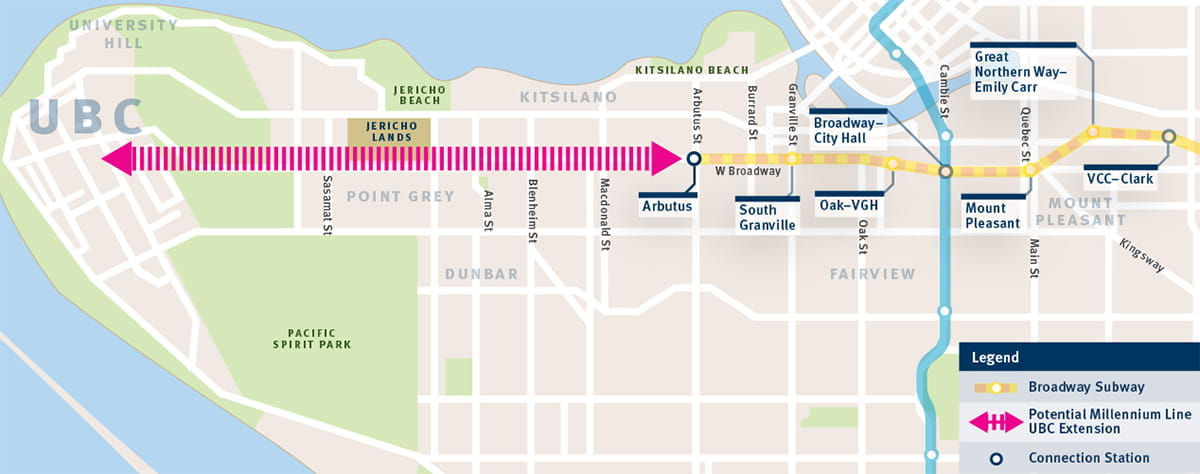
This $5 billion+ project, discussed, advocated, planned, considered, backslided, and generally bandied about over the past two decades, is a kind of political talisman for Vancouverites. It's a something that (almost) everyone wants and successive governments have campaigned on, but no one has yet to build.
To see how little has changed, here's beloved local urbanist Uytae Lee, asking when we were going to build this eight years ago.
Rail projects, whether above or below ground, are notoriously hard to build in North America – and even more so to fund. As frustrating as it is to see us waste time here in Vancouver, we're hardly alone.
Boston's North–South Rail Link has been on the books since 1912, and although it came close in the 1980s, it was traded away to stop Reagan from killing other urban renewal in Boston. Despite its broad benefits and numerous plans to deliver, it still sits in study-land.
Baltimore's Red Line, first proposed in 2002, got further: environmental studies and engineering were completed for this 14-mile line that would have united African American neighbourhoods across the city. But it was killed by the Governor in 2015 as a "boondoggle," who promptly gave the money to suburban highway expansion. It may still have life, but its pathway forward is unclear.
The proposed High Speed Rail to link Toronto and Montreal has been studied for fifty-eight years and counting. From early studies and technical work in the 1980s, it came to a close call in 1995, but governments backed off when they saw the then-$18 billion price tag. After dallying with the poor cousin of high-speed rail ("high-frequency") in the 2000s, the Government of Canada announced in 2025 it would go all the way and build a true high-speed line – only in 2026 to say that the project needed a final business case in 2027 and would not necessarily go forward.
What's the common thread through all of these projects?
Complexity. Complexity that bumps up against politicians' need not only for coherent narratives, but for solutions that felt achievable (and affordable) within what they have in their purview. I see a worrying feedback loop here that is at the heart of our democratic malaise this election:
When you get elected promising to do something, your motivation as a politician is, in fact, to get that thing done. But as our political language, and the decisions guided by it, drive steadily more towards confidence and intuition, the incentives to speak about and then act on complex problems run in the opposite direction. At best you get vague platitudes about the need to act on climate change, the deficit, the housing crisis, or otherwise; at worst, you hear nothing at all.
And should you decide to be an iconoclast and do something large and potentially transformative, the political incentives for your opponent run towards confidence and intuition. Your project will be too expensive and too complicated, and their answer will be to "simplify" and do the obvious, intuitive thing. Because they understand these same incentives, they will be unlikely to promise something at a scale or complexity of what you have just attempted.
The result is a merry-go-round. Promises half-made, half-kept, and all the while a cynical public growing frustrated that we can never seem to get anything done. A public craving someone who can cut through the bullshit and do something, anything, even something destructive, if it feels like it will propel them from this maddening limbo.
Who does that remind you of?
We can build and pay for big things
Near the heart of the breakdown of all of these projects is the knotty relationship between complexity and cost. These are massive, highly complicated, and therefore expensive infrastructure projects to build. North Americans in particular are pretty bad at these kinds of projects. Canadian transit projects that are mostly tunnelled average $751 million per kilometre, compared to $108 million per kilometre for the first phase of Milan's fully underground M5 metro, a gut-wrenching, nearly sevenfold difference.
There are two solutions to this:
Firstly, just do everything that Bent Flyvbjerg and Dan Gardner lay out in How Big Things Get Done. Build strong teams of experienced people that know how to do complicated work. Plan intensively and expansively, but execute in small, modular components. Build strong coalitions in favour of the project. Learn iteratively and recursively improve the project. None is a silver bullet, but executed together and successfully, they mean you can deliver.
Secondly, get real about the financing. Most municipal politicians' plans for how to pay for big infrastructure amounts to holding the cap out to senior orders of government. That may have been possible a decade ago, but with BC on the downward slide of multiple credit downgrades and the Feds cutting the "permanent" transit fund, it's deeply unserious and, though seemingly good politics, actually prevents those leaders from receiving the praise for actually getting something done.
So, with this in mind, pissed off about endless promises and no serious way to pay for them, I built a model.
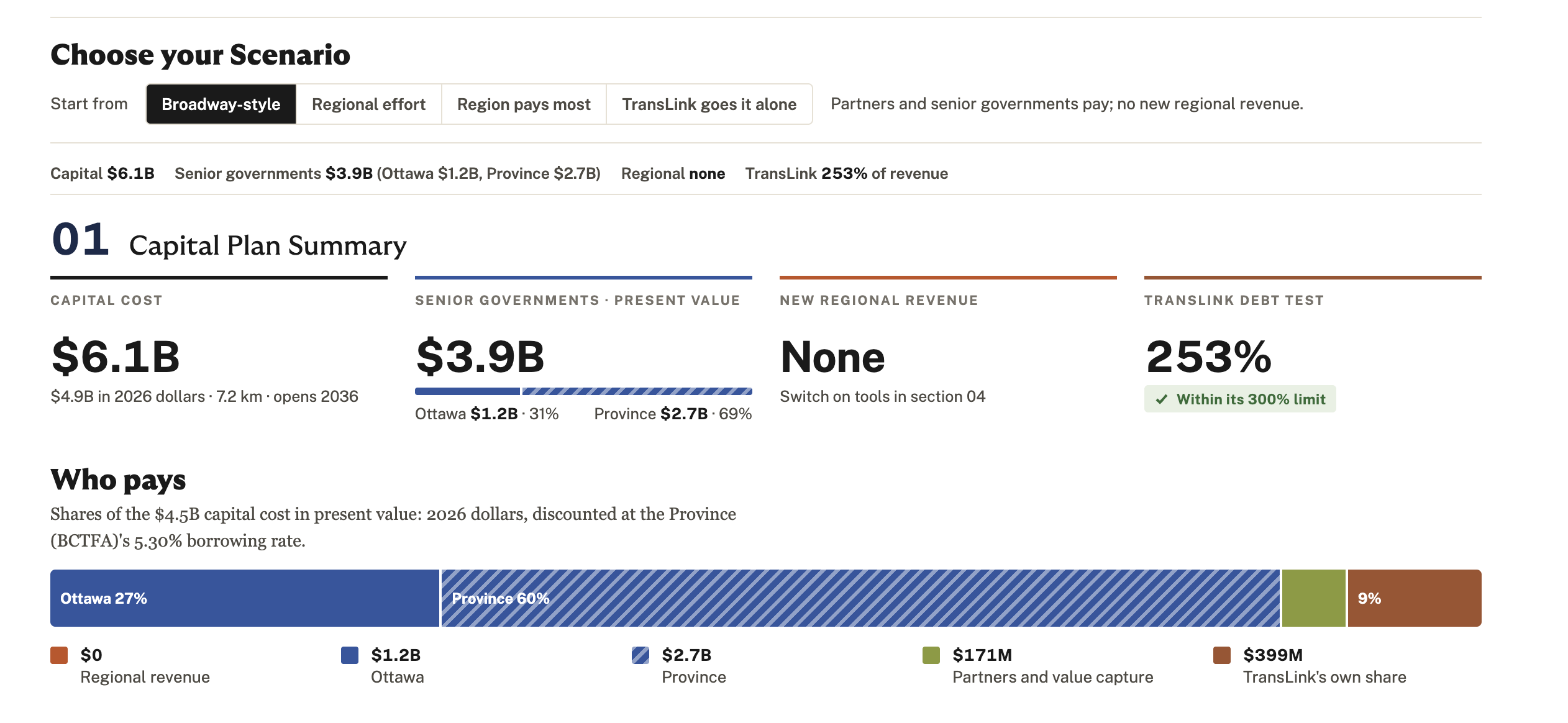
Using off-the-shelf data and some assumptions about what kinds of financial tools could be used, I mapped out (with some AI help) a way to pay for the full train to UBC and, if you were so inclined, keep paying for transit expansions in Metro Vancouver forever.
Building on past studies (and with some help from my AI intern), it maps out:
- Price pathways: about $4.9 billion in today's dollars ($6.1 billion as spent) for 7.2 km and four stations, opening around 2036 if construction starts in 2029.
- Traditional funding pathways: Victoria and Ottawa contributions, Broadway-style, that cover about $3.9 billion.
- A range of regional revenue tools: a $60-million-a-year property levy (about $49 per household) plus third-party contributions, such as UBC, all the way up to a regional sales tax that could bring up to $860 million at 1%.
- Institutional considerations: TransLink has limitations on its debt to operating revenue (300%), and there are potential pathways to navigate provincial debt challenges by changing who "holds" the project.
All of this work rests on a really simple premise: people want good stuff far more than they care about where the money comes from. North American governments today are consistently the epitome of penny-wise, pound-foolish with the stop-start approach they take to big, public projects. The subway systems in London and New York City are the poster children for this. Eye-wateringly expensive in their day, but now beloved and unassailable public institutions.
I am not arguing for fiscal profligacy; some projects actually aren't worth it. But successfully building something you campaigned on is one of the single greatest guarantors of political success in addition to, you know, helping people.
What my model shows – building on the very serious analyses of others – is that it's possible. We can build big, complicated things and we have ways to pay for them.
You even get to choose how we do it, if you want to play along below.
Towards a politics of the hard, boring, and meaningful
The hollow promises our politics makes about infrastructure or taxes or services don't have to be this way. We have the tools and the know-how to deliver complex things that benefit the public in big ways. But we need our politicians to recognize that -- and more importantly, we as voters need to reward them when they do.
I used the example of transit in this essay because it's something directly relevant to me – and millions of other people in Vancouver – but I could have just as easily built something looking to expand the military, build more hospitals, schools, or a pipeline. All the model does is look seriously at our technical and financial capacity and asks you to make decisions.
In making these decisions, you showcase the principles for what a meaningful political promise really is:
- It involves trade-offs and explicit costs
- It takes a moment to understand, because it takes on the full scope of an issue
- Whatever is promised takes time to unfold; it doesn't happen overnight
If someone makes a promise like that to you, listen. They're not just talking with intuitive confidence; they're talking like someone who wants to govern.