
"hi im levent!!!" bursts out energetically in a striking counterpose to the Times New Roman font on an otherwise suspiciously dour, all-white background.
This is the personal website of Levent Alpöge, the Harvard mathematician and Anthropic employee who on Friday released a simple document titled "Remark," wherein he claimed that he and the AI model Claude had solved one of mathematics' last great unanswered problems: the Riemann hypothesis.
Although I am not a mathematician by any stretch of the imagination, years of listening to my friends who are or work in adjacent areas have given me some insights into the field's shape, and the potential historical weight of this claim and what it would mean for our understanding of the world.
Despite the fact that the "Alpöge–Claude proof," as I will call it, still faces considerable scrutiny (and is in contention with a solo human proof released the same day), I think this is an inflection point in the relationship between human and machine intelligence.
As I will lay out in this essay, the announcement a week ago builds on an increasingly feverish proliferation of AI in mathematics, physics, and other scientific disciplines. I think Pandora's box has been fully opened on the use of AI in research, which promises meaningful possibilities at the same time as it creates profound risks.
I want to take a few steps back and reflect on how we got here and what may lie ahead, and to offer thoughts on the systemic reforms we need to make in our systems of science and research in light of this, and how these are intimately tied with the urgent need to slow down the development of more advanced AI.
Increasingly machinic mathematics
Mathematics and technology have always been intertwined.
From the early use of geometry in farming, trigonometry to determine the radius of the Earth, the permutation theory and logic that helped helped lay the foundations for modern computers, to the linear algebra at the heart of large language models (LLMs) themselves, this has always been a two-way relationship. Math has inspired ideas that drove forward technology, and technology has inspired mathematical exploration while also enabling its advancement through new tools (e.g., "automated proofs").
For AI and math specifically, while there were some early blips in the 2010s using deep learning, it wasn't until 2022 that LLMs specifically really took off. By 2026, things were starting to look parabolic.
In "The Gold Rush for AI4Math," Jin, Ke, and Sui analyze math-related submissions to the open source pre-print platform, arXiv (sidebar: I did a little deep dive on it in May). Their analysis found that:
- "Disclosed AI use increased sharply over the study period, with substantive use growing from 1.39% of Mathematics submissions in March to 14.09% through August 20."
- The use of AI in "substantive research" was focused on "AI is already being applied to open research problem [i.e., solving theoretical, foundational problems, not just running data]" and that among the 717 open-problem papers "71% are labeled as fully resolved based on the authors’ descriptions," usually with a positive proof.
- About 2/3s of weighted author counts were concentrated in the United States in China
Researchers at Epoch AI highlighted similar results recently, showing both the increase of the general use of AI (e.g., proofreading, formatting) and where it was used for "substantial research."
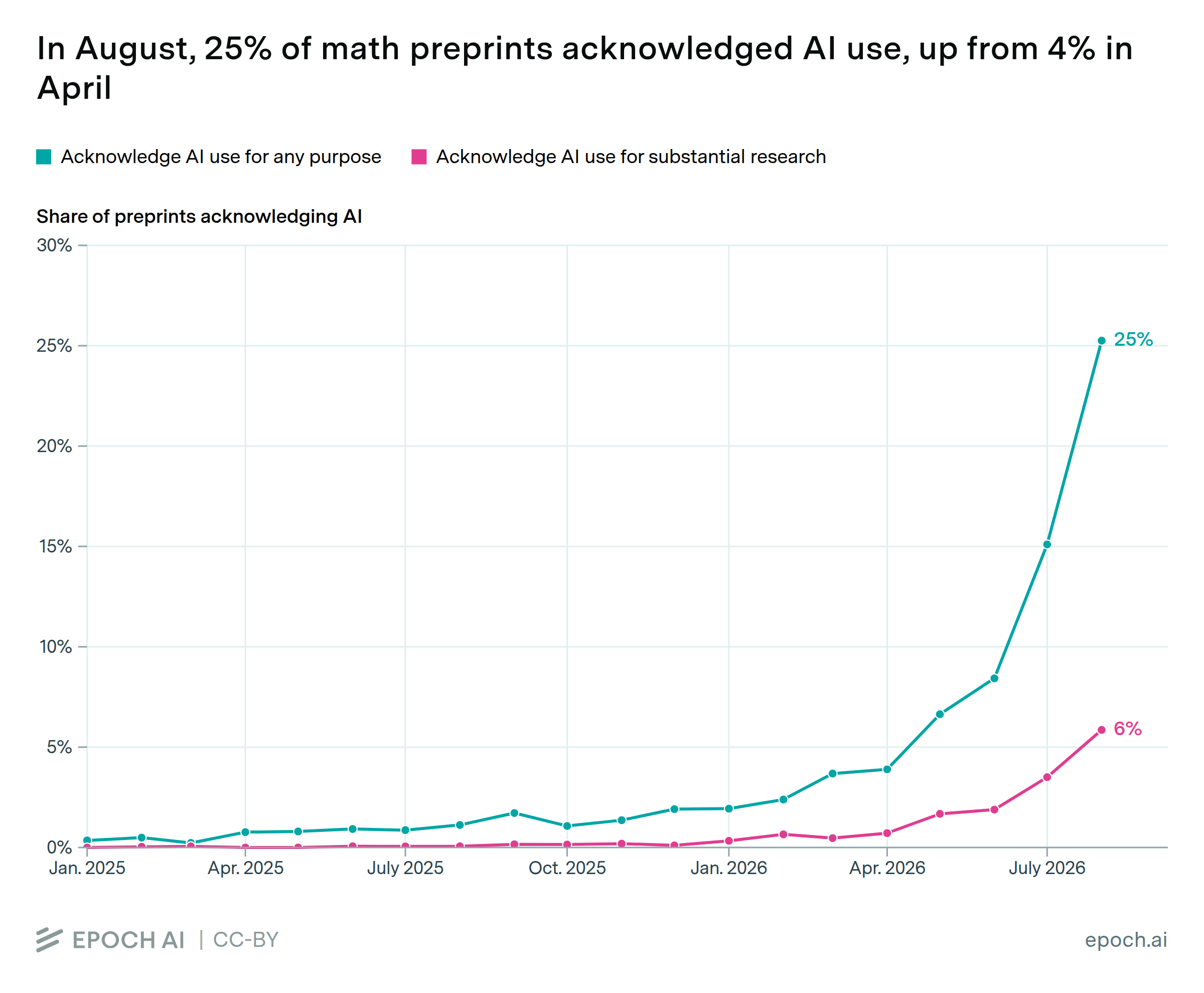
While there are many reasons to fear and reject for the hidden use of AI, Epoch's analysis was run looking at both the general population and researchers who had been publishing regularly since before 2023 – and who had disclosed their AI use. The difference in AI usage between them was within 1.5 percentage points.
Substantial research is where the real heavy-lifting is, and since this summer, it's driven some striking outcomes. First when researchers used Google's DeepMind to make a series of impressive contributions. As the editor's note in Science summarizes:
Tsoukalas et al. [used] large-scale deployment of an LLM-powered formal proof search on open research-level problems (see the Perspective by Avigad and Ballard). Their framework, called AlphaProof Nexus, for agents that iterate between LLM-based proof generation and Lean-based proof verification autonomously resolved nine of 353 open Erdős problems, including two that had been open for 56 years, proved 44 of 492 open conjectures from the Online Encyclopedia of Integer Sequences, resolved an open question in algebraic geometry, and improved a known bound in min-max optimization.
At the same time, OpenAI undertook an astounding range of work on the Navier-Stokes equations, which set the uniquely difficult task of trying to predict how fluids move. The researchers within OpenAI reportedly used 10,000 agents that sent approximately between 2.7-5 million messages to each other, and "After 88 hours, the agents running on the internal model had a proof of a singularity in Navier-Stokes, and after an additional 17 hours, another AI model had formalized the result."
Also around the same time, Anthropic took a run at a smaller version of the Riemann hypothesis (which I'll describe below), and while it didn't solve it, it did make some meaningful contributions to the problem-area.
In response to all of this, the Editorial Board at Nature Computation said presciently on November 17, with what I read as equal parts concern and awe, that:
"More fundamentally, [the DeepMind and OpenAI claims point] to the possibility that AI systems may contribute answers and insights that resemble mathematical reasoning to long-standing unanswered scientific questions."
Alpöge-Claude's answer to the Riemann's hypothesis
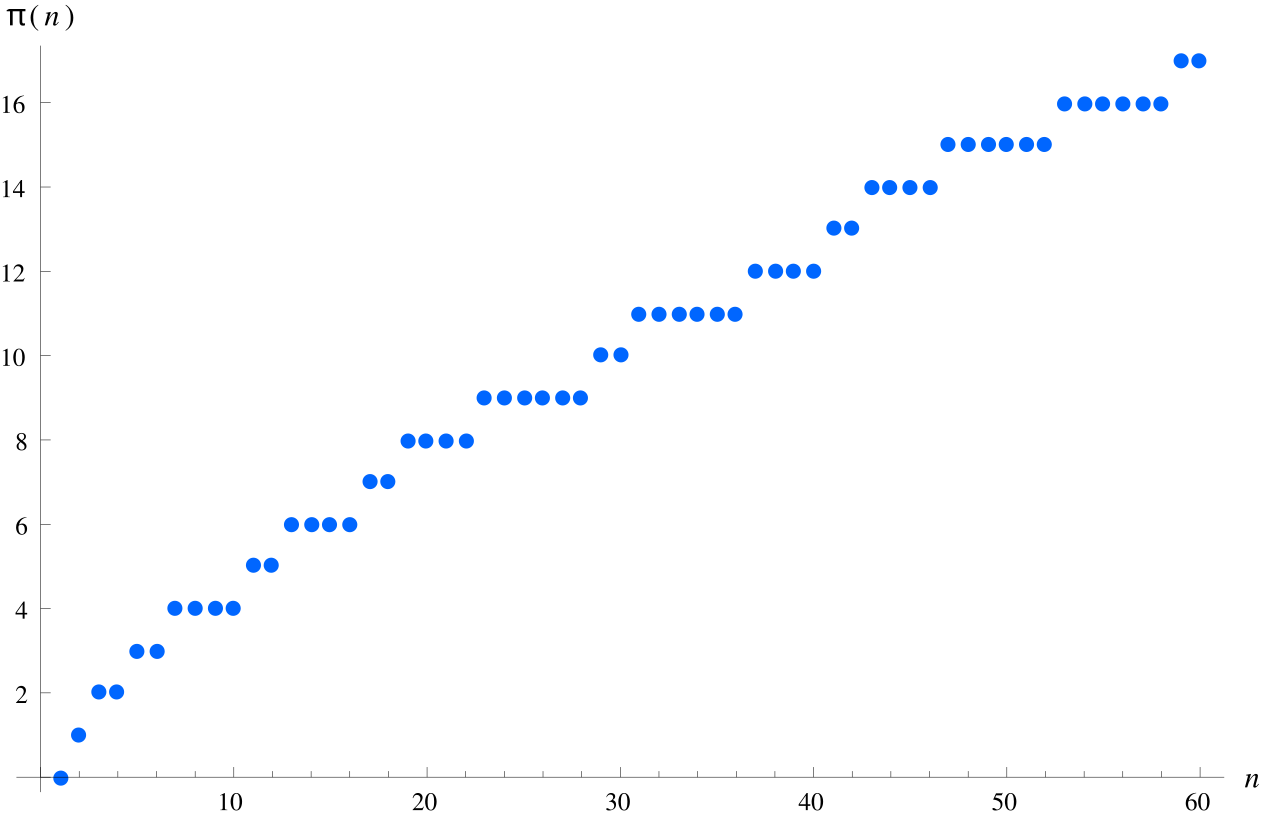
Bernhard Riemann was a German mathematician who most famously tried to understand why prime numbers (e.g., 2, 3, 5, 7, 11...), which are the "building blocks" of all other numbers, appear in a seemingly irregular pattern. The early primes are relatively close together, but near 1,000 only about one in seven numbers is a prime, and near a billion, only one in 21.
Riemann's "zeta function," created a formula for understanding how this distribution works. And though we've never been able to fully prove it, many mathematicians take it as a given and press forward.

On November 20th, mathematician, junior fellow of the Harvard Society, and Anthropic employee, Levent Alpöge, posted on his personal website that he believed that he and Claude had proven Riemann's hypothesis correct.
Curious, I went to Alpöge's personal website and read his statement, simply titled "Remarks."
In it, he talks about planning decades worth of work on this area in his early student days and how he worked to understand as many tools as possible in order to break through 150-years of uncertainty since Riemann first proposed his solution. He came to know one of his tools particularly well:
Claude and I have had a great time together with such breadth in recent months, but this time Claude far outpaced me near the finish line. No, Claude flew, and danced, and sparkled near that finish line. I had us on the line of combining two quite different ideas present in a toy setting, one of which was already new and shocking, making very simple one of the shadows of Riemann over which we mathematicians felt most triumph. I guided us to the right situation analogous to that toy setting, and then Claude began to leave me in awe.
He then goes on to describe a dizzying range of approaches, sources, and considerations, that he himself calls "an astounding amount of mathematics" and far more than he would have ever thought needed when he first wanted to work the problem.
The range of inputs and the full scope of the work was so large – a human-readable format would have run 250,000 pages – that he decided to release the work in a huge set of Lean files, which allow for the automatic checking of proofs to see if they make sense, rather, he said, that posting a "massively unreadable travesty of slop."
With strange humility for someone who may have, in partnership with a machine, solved one of humanity's greatest mathematical problems, he notes that he is not "presenting the world with a complete statement," since it is merely file to be machine-checked. More strikingly still, he notes that he himself has not mastered the "massive neighbourhood" of mathematical schools that are part of the proof.
The news around the release has been breathless, in particular given that it came out a day after Anthropic's titanic $1.3 trillion valuation arrived on the stock market on November 19th, and that a separate, also non-peer reviewed but entirely human proof, was released within hours by Alessandro Masullo. The beautifully named Music of the Primes is a 940 page-long proof, posted, bizarrely, on the American Mathematical Society's President's, Ravi Vakil, personal website.
So far Masullo's proof has already had a few chinks in its armour identified through crowdsourced checking on GitHub and other feedback, and the Alpöge-Claude proof has repeatedly passed checks through different mathematicians' use of the Lean tool. A joint statement by the Lean and Mathlib communities, endorsed by the research organization behind Lean and the Mathlib Initiative, said that the Alpöge–Claude work had passed all checks they could run. That confirms the code is logically valid. But without a formal written proof, the hurdles that Alpöge and Anthropic will need to clear are still many — not least acceptance by the mathematical community of such an unconventional process.
Josef Waples put the stakes well:
One is a Lean formalization from a serious mathematician at Anthropic, built with Claude, that anyone can download and compile. The other is a twelve-year human manuscript from a Stanford postdoc that one of the field’s toughest reviewers has been checking for months. Behind both is a year in which AI-assisted results in mathematics have mostly held up under scrutiny.
Where is this taking us?
Large language models, along with forms of machine learning, provide researchers with a set of opportunities that will extend across multiple fields, not only mathematics. Though not necessarily immediate in their impact, over time, I think these three core facets of machine-inflected research will prove the most transformative:
- LLMs enable us to combine vast amounts of data and undertake complex, often iterative analysis on it in uniquely fast ways;
- LLMs enable us to systematically draw on the insights, tools, and data of wildly diverse fields (as seen on a smaller scale with Alpöge) to attack problems from new angles;
- LLMs will (for thoughtful users) create more ways to stress-test and double-check assumptions from a critical outside perspective, particularly across complex and longer-term analyses.
I think the future of leading research in many, though not all, domains will rest on combining some aspects of all three of these facets of LLMs.
But that opportunity is not without considerable danger.
A new "Bone Wars"
Between the 1870s and 1890s, there was a rush in the United States to uncover as much as possible about newly discovered dinosaur fossils.
In their "race" to identify as many dinosaurs as possible, the two chief actors of the "Bone Wars," Edward Drinker Cope and Othniel Charles Marsh, would leave frayed academic relationships, particularly between European and American palaeontologists; physical destruction of fossils through sabotage and carelessness; and misconceptions that grew out of their speed and sometimes-slapdash methods that would take decades to unwind.
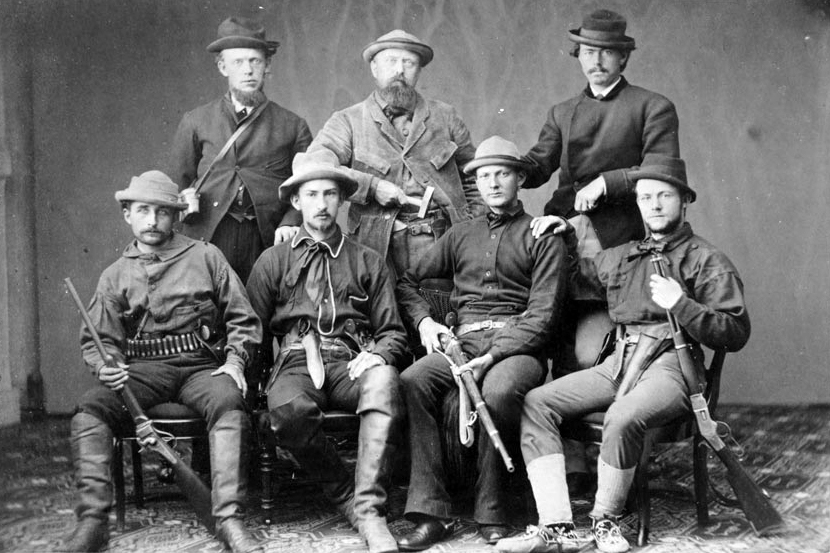

At the same time, the Bone Wars would popularize the idea of dinosaurs with the public, and leave a lasting legacy of species discoveries like Triceratops and Stegosaurus. Most importantly, significant scientific concepts, like Marsh's argument that birds are descended from dinosaurs, were born out of this feverish activity.
I see many echoes of this historical moment today. The back and forth between OpenAI and Tristan Buckmaster and Alpöge about credit for the Navier-Stokes result, and, to a lesser extent, now between Masullo and Alpöge, both speak to a worrying commitment to speed. All of these discoveries break down important traditions in how science is evaluated and debated, and do so within a context where "winning" can be associated with immense financial gains.
But there is an even broader issue: because of the positive publicity (and financial gains) associated with these mathematical (and likely soon other) discoveries, the AI labs are increasingly turning their attention not only to math but also, especially, to biology, as a way to earn "social license" for their work.
The output of these companies, and those using these tools more broadly, will be voluminous. It may overwhelm many of the processes, like peer review, that we use to try to ensure fairness and quality in knowledge that is produced. We don't know yet what we might lose amidst this new rush.
Market concentration risks
Nothing could be less fair in all of this than the inequity in who gets to use these models.
It is not yet clear from Alpöge's statements which Claude model he used, but it is very likely it was one of the newest, strongest internal models that have not been released to the public. As an Anthropic employee, it seems profoundly unlikely he was paying for the usage, which, by way of comparison, cost OpenAI anywhere between $6 million and $15 million when it tackled the Navier-Stokes equations. And despite his protestations to the contrary, it is difficult to see that the decision to release his results within days of Anthropic's massive IPO are was entirely separate.

For any employee of the company to benefit from the use of internal tools is not uncommon: the era of the large corporate lab (roughly from the 1950s to 1980s) saw significant advances in science and engineering through company employees using internal resources. But there is a tremendous difference between having access to specialized equipment and labs, and what the internally available compute and pre-public models make available to researchers within AI companies. This is in addition to — as the controversy over how OpenAI presented its Navier-Stokes research shows — the complex questions of authorship and intellectual property that are at the core of ongoing legal battles with these companies (which was actually my original entry into the AI conversation three years ago).
Researchers could find themselves facing not only a cartel of providers who dictate prices and siphon off academic resources, but one that exponentially amplifies the "haves and have-nots" problem in the resources needed to conduct leading research.
Breakneck transdisciplinarity
I believe one of the strongest opportunities in the use of LLM-driven research, as touched on by physicist Adam Brown at Google DeepMind, is the enablement of transdisciplinary research. As with Alpöge, the ability of LLMs to help Brown understand disparate parts of his own discipline has meaningfully accelerated his work, rounding out his understanding quickly and giving him new tools to drive research. Respected climate scientists had a similar experience this year in assembling a large-scale assessment on climate risks, while still noting the critical role of human judgement.
These intra-field travellers generally seem cautious and thoughtful, but I believe the temptation to range further and further afield will only grow.
As I discussed in my essay on reading earlier this year, there are significant risks here around "epistemic trespassing." While blending the insights of disparate fields is the hallmark of much groundbreaking research, there is a particular danger that the smoothness and ease with which LLMs help us cross into new fields will make us careless and presumptuous. I have been critical of economists in particular for this kind of thinking historically, but the easier it is to jump across fields, the greater the risks for us all.
Even for the well-intentioned, rigorous researcher using these tools, I also see structural challenges in a core function within our intellectual establishment: peer review.
The speed with which new research can now be produced, and the potential breadth of disciplines that may be included within a single project, will put strains on a system that is already breaking down. Finding enough qualified peer reviewers for articles today has already been named as a crisis; how will we move forward when academic output overall radically increases at the same time as the complexity (leaving aside the question of quality) of projects also steadily increases?
God proofs
The interviews with mathematicians about an LLM-derived proof for the Riemann hypothesis, done by 3Blue1Brown, a popular math YouTube channel, lay out a more profound concern that I think lies at the heart of the epistemic anxiety that I and many others feel at this moment. As argued most cogently by Adam Brown in those interviews, mathematics has historically brought together the desire to prove something with an equal desire to understand something. LLMs, he says, raise the spectre that those two things may come apart. The more we push LLMs into deep, unanswered questions, the greater the risk we may receive "notes from the Gods," telling us that things are true without being really clear on why they are true.
Alpöge's work with Claude is the exemplar of this. Rather than produce 250,000 pages of human-readable explanation of the proposed proof, he opted for a machine-readable output that could be checked, but not understood in the full sense that Brown is referring to.
With AI companies increasingly interested in pushing into physical fields, and especially biology and medicine, I think it is extremely likely we will see AI-produced "solutions" in these fields that have complex, believable, and probably even empirically verifiable results, but the full nature of which escapes our human understanding. History is replete with examples of good intentions gone awry because of narrow definitions and unknown unknowns.
Reasserting human agency – with humility
I have laid out why I think this moment is an inflection point because of the volume of AI-supported research that is now coming forward, and the technical and intellectual depth that some of that research will contain. This places considerable stress on systems, like peer review, that are crucial to how we develop knowledge, but may yet also create even broader societal risks — particularly as LLMs are used in more and more physical fields, especially biology.
The use of AI in how we produce knowledge, to leave aside even larger questions of economics and power, poses real threats to which I have only bare-bones answers. But I do want to be clear that these are not insoluble issues. One of the defining political issues of our time is apathy born of hopelessness; I refuse to accept that premise and I hope you do, too.
Building on longstanding work to improve research processes in relation to the decades-long "replication crisis" in science, and pulling in other ideas from AI governance and elsewhere, I think there are five areas of work we must undertake within the academy to shore up its foundations:
We must re-ground scientific review and evaluation in processes that actually enable meaningful consideration and remove the perverse incentives that warp the intended societal outcomes of research. There are suggested reforms to peer review that include paying reviewers, capping how many papers each author can submit a year, requiring authors to review as much as they publish, and bringing in non-academics for review. The Coalition for Advancing Research Assessment (CoARA) systematizes these kinds of ideas in its 2022 Agreement on Reforming Research Assessment and adds a few more focused on how research institutes can assess academic performance on more than just journal output, reward participation in peer review, and abandon easily gamed quantitative ranking systems (e.g., h-index). Broader still, we need to overcome the maladaptive evaluation structure that has created the replication crisis and create strong rewards for reproducing results, not just creating new ones.
We must change the commercial incentives within systems of science and research more broadly. One of the more radical, but probably most impactful, moves would be to eliminate or at least radically restructure the system of for-profit scientific and research journals. These private companies collectively make billions from subscriptions and "access fees," and yet still largely rely on a slow, volunteer-run peer review process that is increasingly breaking down as research becomes more interdisciplinary. Whatever their other faults, researchers like Alpöge can be forgiven for wanting to break free of a system that is slow, sometimes capricious, and extractive. Mandatory open access publishing requirements from funders can be one pathway towards this, but at some point, these companies' aims have to be seen as counter to the scientific project.
We must use antitrust tools to ensure a functioning market and invest in equitable access to open-source, open-weight models. At the same time as commercial incentives within scientific publishing must be changed, so, too, must models that can be used, adapted, and built on independently be made available in equitable ways to researchers and the public more generally to prevent total dominance and perverse market-shaping by the two or three largest actors in the field. There will be risks that need balancing in terms of safety, but with some of the above steps, I believe these can be managed.
We must curate and reward diverse, respectful, and productive interdisciplinary collaboration. To become a tenured academic, you are expected to publish considerable numbers of noteworthy (as seen through citation-counting indices) academic articles. You are also expected to teach, though the quality or impact of that teaching is not meaningfully considered in your advancement. Neither of these necessarily rewards curious, thoughtful collaboration with people outside of your own discipline. Time and space to engage thoughtfully with people is the answer. The development of cybernetics is a notable outcome of the Macy Foundation-funded conferences — 160 over 19 years — which brought together leading experts across disparate academic disciplines, originally to tackle problems in medicine. Though rare, open-exploration, fully-funded spaces like this do exist today, such as the Santa Fe Institute, but even for those who can make it into one, you still face the crush of publishing and teaching.
We must use new and blend old epistemological tools for understanding and evaluating machine-generated discoveries. Adam Brown's concern about what I have called "god proofs" is prescient (though not all share his concern). We lack the tools and frameworks to decide what kinds of machine-derived claims we want to actually listen to, and what we feel comfortable doing with them if we determine they have validity. Some will readily accept the work of machine intelligence, while others, like James Owen Weatherall and Jesse Wolfson, have argued that regardless of their usefulness, AI-generated proofs have no inherent value in themselves, but rather only insofar as they catalyze dialogue and momentum among human mathematicians.
These are not merely the arcane debates of mathematicians. Rather, they mirror the much larger battle over whose ways of knowing — Indigenous, African, Western, Indian, East Asian — count, and why. And because LLMs have largely emerged from Western ways of knowing, moving outside of that to bring in epistemologies that challenge some of our basic assumptions will be crucial, especially ones like Etuaptmumk ("two-eyed seeing"), as shared by Mi'kmaq elders Albert D Marshall and Murdena Marshall. Two-eyed seeing and related approaches usually emphasize that knowledge is "not just a relationship between humans," but rather a "more than human" practice that understands that knowledge emerges from diverse places and will often break simple categorizations. This requires at its core, as many Indigenous scholars have argued, something that goes beyond mere institutional ethics focused on risk reduction; it rests, instead, in intellectual humility and a wide-ranging relational ethic of care that doesn't just stop at the threshold of the laboratory, but goes into the whole world.
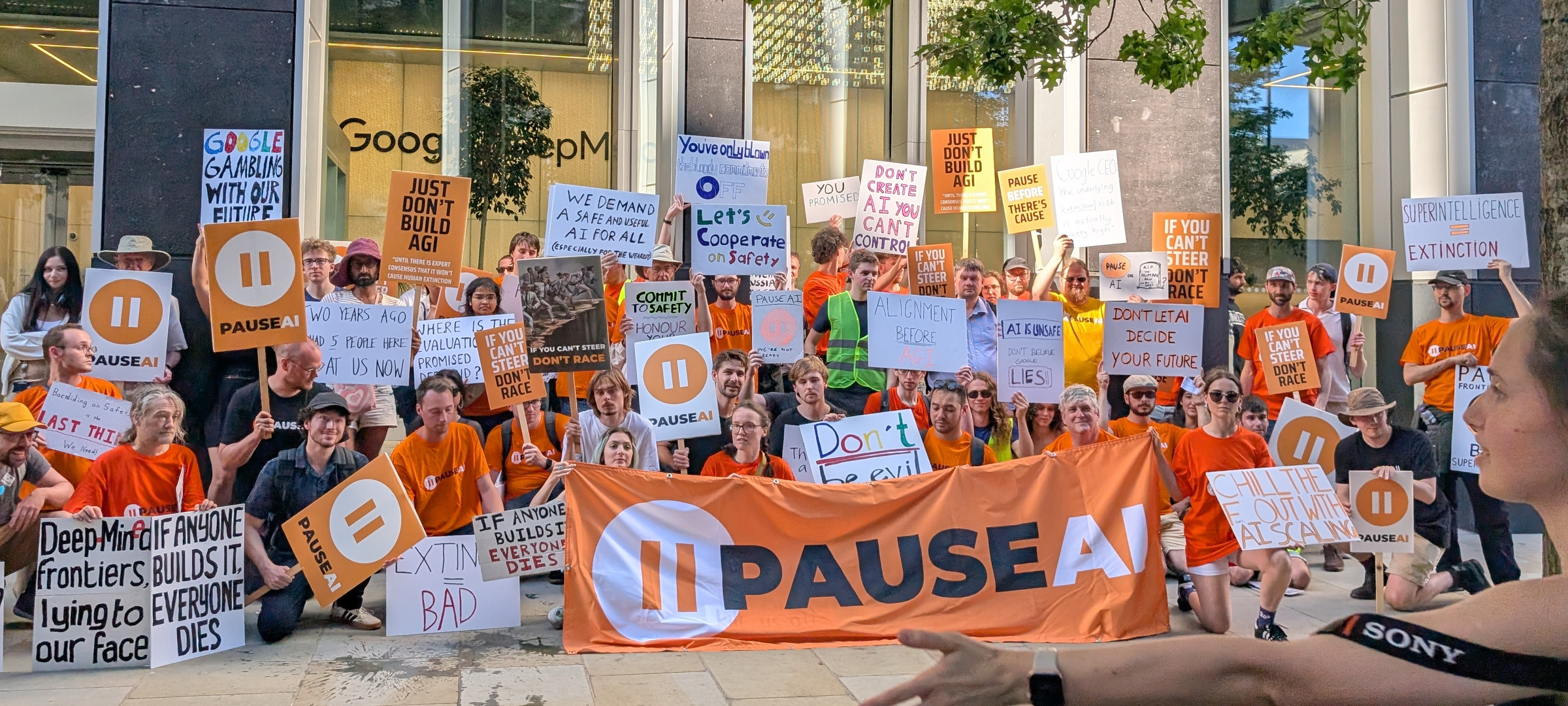
It is from within this wider epistemic and ethical framework we must also think beyond these abstract questions of knowledge creation and attend to real-world impact. The race to increase the capacities of LLMs whatever the costs, from societal cybersecurity threats, to biohazards, to climate damages, is no longer tenable or responsible, and so we must slow the development of new AI models in thoughtful, strategic ways.
The AI Futures Project, Anton Leicht, and others have laid out variations of ways to "pace the frontier" in practical terms. They usually include immediate measures related to cutting the amount of computing power put to new model research ("input-limiting," or "verified compute allocation disclosures"), the use of "safety-gates," where third parties (and, perhaps, "embedded evaluators") get to test and approve any model for key safety considerations before it is released. Some also include a version of "speed-limit pacing," as Leicht calls it, which would place explicit limits on the development of new capabilities in models for all developers. This must also be embedded in frameworks that protect against the environmental and social impacts of data centres.
Shifting our epistemologies and changing, in some cases, centuries-old traditions in the academy are both daunting and sometimes profoundly abstract. I think it's important to ground ourselves in the reality that, no matter the vast computational power undertaking work of awe-inspiring complexity to help us humans better understand the world, it is indeed humans who are still driving this all. Alpöge said that he had, with the help of Claude, made a momentous discovery. Human agency still underlies, at least for now, how these incredible, imperfect, sometimes impetuous discoveries are made.
Fifty-odd years ago, a greeting much like the one on Alpöge's website graced a computer screen. It simply read: "Hello, world."
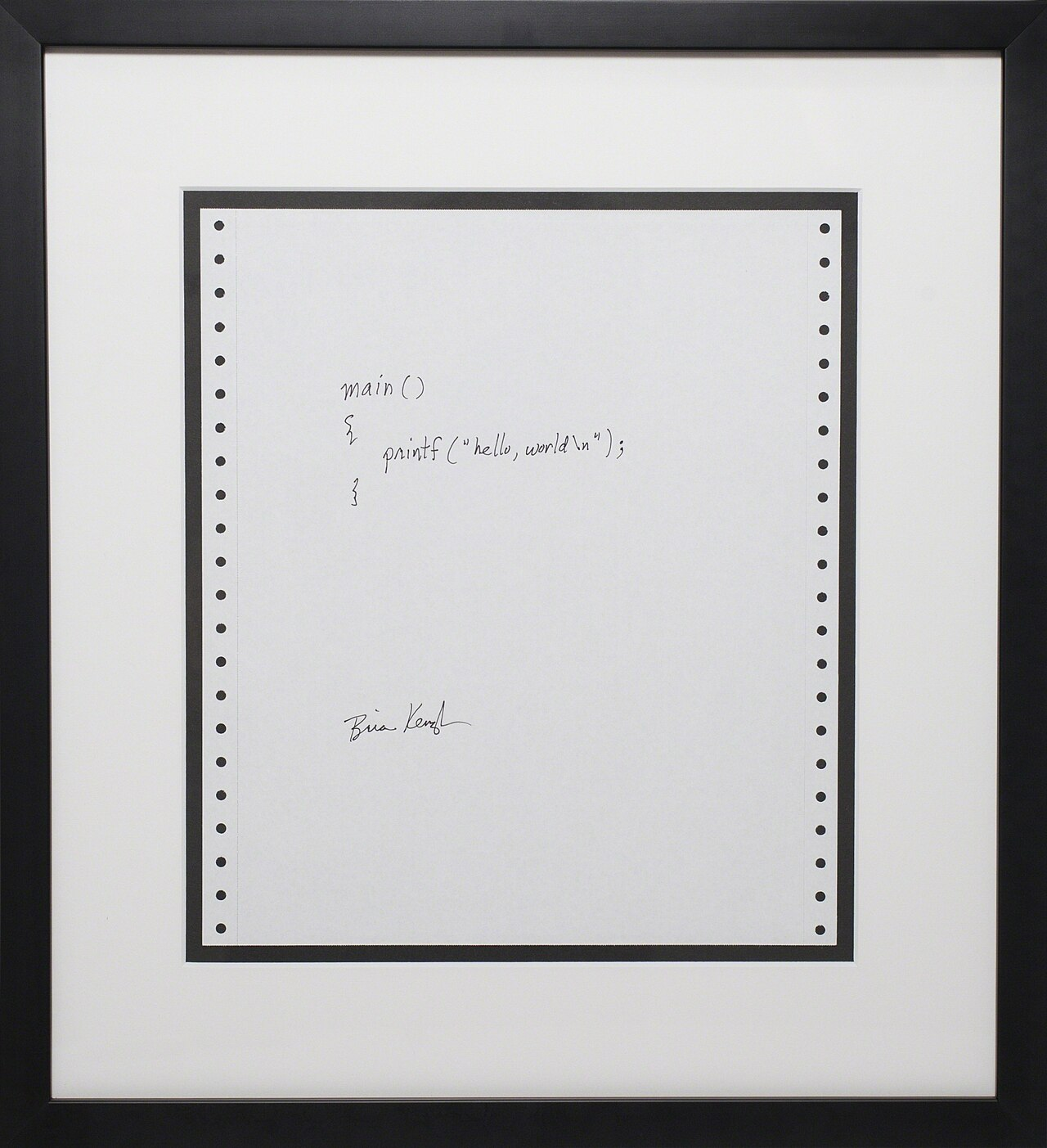

This simple, friendly phrase was a practice prompt from Brian Kernighan, in one of the first programming tutorials, which taught people to put something into a computer and get something out. He couldn't have known where we would end up now, but there's something fundamentally instructive here: the greeting was to the world. Not to a user, an owner, or a master. Whatever we ask of the machines we continue to make, we should be clear that what emerges is created for the world, and all of the relational responsibilities that are entangled within it.